Friday, March 1, 2013

Oxford opera


Endeavour 2012 U.K. PBS Masterpiece Mystery! (103 minutes) written and devised by Russell Lewis; directed by Colm McCarthy; based on characters created by Colin Dexter.
‘Bad’ makes noise and stinks, but less often than not gives rise to the evil necessary to commit murder most foul.
In this story, sexual jealousy undoes a tidy blackmail set-up involving underage schoolgirls and bent cops, politicians, and government officials in mid-1960s Oxford.
Oxford City police bring in out-of-town help to find a missing teenage girl who turns up naked and dead in the woods. Police set about rounding up the usual clichés: a naïve young ‘redhead well-developed for her age’ fell in with the wrong crowd and got into trouble, and boys will be boys—especially old boys who should know better. It’s a tragedy, but life goes on.
That is, for all but one out-of-town rookie police constable brought to Oxford for his ‘knowledge of the local terrain’ as a former Greats candidate: Detective Constable Endeavour Morse (Shaun Evans).
Young Morse wonders what the devil a schoolgirl was doing with expensive first edition hardback poetry volumes place-marked with a series of Saturday crosswords clipped from a local paper. In each instance, only the first across and the last down of each grid is filled in; the acrosses are place names in Oxford, the downs are numbers.
Detective Constable Endeavour Morse (Shaun Evans) investigates the victim's reading
A loner who carries his resignation letter ready in his breast pocket, Morse has a thing for opera and crosswords and knows English Romantic poetry. His classical training and knowledge, intellectual curiosity, and a single-mindedness that makes him all but impervious to intimidation become crucial to cracking what turns out to have been ‘an almost perfect crime.’
This movie is a prequel to the Inspector Morse series starring John Thaw in the title role that Masterpiece Mystery! ran from 1987-2000. It is rich with references to the long-running series, not to mention Morse’s red Jaguar, Morse creator Colin Dexter behind The Times at an outdoor table at an Oxford pub, and Thaw’s daughter Abigail Thaw in a cameo as an Oxford newspaper editor. Thaw himself momentarily looks back from the rearview mirror at Evans’ Morse behind the wheel of a police car.
But the best thing about this prequel is that it and its star move comfortably in their own clothes in a well-cast, well-made, well-spun whodunit. In this spirit, the film calls itself by Morse’s first name, Endeavour, which fans of the earlier series know that Thaw’s Morse never used (and mentioned once only in an unguarded moment).
Evans might not be the first actor one would have cast for this role. He is ideal in it though, because he clearly understands the character and it is a pleasure to watch this young actor begin to become the man the middle-aged Thaw made flesh. (A series of four more episodes has been made but not yet released.)
'Good cop' Detective Inspector Fred Thursday (Roger Allam), Morse's mentor. 
Evans is supported in this role, and as a rookie cop, by Roger Allam’s excellent Detective Inspector Fred Thursday, a ‘good cop’ who represents everything that Morse likes about police work, and Danny Webb’s equally good Detective Inspector Arthur Lott, a ‘bad cop’ who stands for everything Morse dislikes about the police and which accounts for his letter of resignation.
Subsidiary to these is the cheerfully facetious and pedantic coroner (Is there any other kind?), Dr. Max DeBryn (James Bradshaw), who tells a squeamish Morse at his first crime scene, ‘You won’t make much of a detective if you’re not prepared to look death in the eye.’
Morse is not impressed by academics such as his former fellow student Alexander Reece (Christopher Brandon) nor Dr. Rowan Stromming (Richard Lintern), a Classics tutor. He is impressed the less so when he discovers the two had a £5 bet regarding Stromming’s Pygmalion-like ‘tuition’ of Mary Tremlett (Rachel Heaton), their dear-in-the-headlamps who ends up dead in the woods.
Mary Tremlett (Rachel Heaton), an Oxonian 'dear-in-the-headlamps.'
Shortly thereafter, Miles Percival (Harry Kershaw), Mary Tremlett’s former beau and one of Stromming’s undergraduates, apparently shoots himself on the riverbank—Morse’s first crime scene.
Morse subsequently discovers that Mary and some of her school friends attended ‘parties’ for influential older men, including Sir Richard Lovell (Patrick Malahide), minister for Overseas Affairs and constituency Member of Parliament for Oxford North. One of Mary’s friends is Jenny Crisp (Daisy Head), daughter of Detective Chief Inspector Crisp (Terence Harvey), who commands the city police force.
Teddy Samuels (Charlie Creed-Miles), a spiv Jaguar dealer with an edge, arranges these fêtes. They take place in a mothballed great house formerly owned by the Earls of Oxford, though since under the sketchy supervision of the Treasury Department. The house appears to fall within the purview of a shadowy ‘Special Branch’ chap who owns only to the name ‘Dempsey’ (John Light).
The murdered girl has an adoring older widower father Stan Tremlett (Ian Gelder) and a resentful older sister, Sharon Veelie (Emma Stansfield), married but separated from her husband, who has a connection with Samuels.
And there is the glamorous opera singer Rosalind Calloway (Flora Montgomery), now Stromming, the ‘beautiful woman with diamond earrings,’ who retired as a performing artist when she married Professor Stromming. It turns out that Morse’s love of opera began with first hearing Calloway sing Madame Butterfly; he can’t believe that his work has given him the chance to meet his lifelong ‘heroine.’ 
A star-struck Morse and his heroine, opera singer Rosalind Calloway (Flora Montgomery).
Morse’s challenge is to figure out how all these moving parts make this peculiar town clock tick. Our entertainment is to spend an hour and a half with this engaging fellow as he goes about doing this.
Apart from the recurring aria, Un bel di, from Giacomo Puccini’s Madame Butterfly (sung by Janis Kelly), Barrington Pheloung composed and conducted the theme and incidental music, as he did in the Inspector Morse series.
After we see Thaw’s Morse look back at Evans’ Morse from the car rearview mirror at the end, we hear Pheloung’s well known series motif based on the Morse code for M-O-R-S-E: Endeavour Morse has become Morse.
Shaun Evans, left, and John Thaw, right, as Masterpiece Mystery!'s Morse.


Tuesday, January 22, 2013

Vanya and Nyurka’s excellent adventure


Печки-лавочки [Pyéchki-lávochki] (Happy-Go-Lucky) 1972 Gorkii Film Studio U.S.S.R. (96 minutes) written, directed by and starring Vasily Shukshin.
This entertaining Soviet comedy contrasts a pair of collective farm country mice with more sophisticated urban Soviet fauna in the heyday of the Brezhnev era in the 1970s.
The humor is sunny. The story has a quietly personal political intensity at its core that made the movie resonate for Soviet audiences. Without being fatally ‘anti-Soviet,’ it has fun showing how ungrounded contemporary Soviet urban life might look to down-to-earth farmers with a foot in the nineteenth century.
The film opens with the expanse of the wide-open steppe and the rhythm of the lives that husband it. It is filled with the bustle of modern train travel, Moscow's quick tempo and Coney Island-like summer crowds on a Black Sea beach. It ends with the protagonist sitting on a home field with his bare feet on the ground.
Vasily Shukshin, the Soviet writer, actor and director, wrote, directed and stars in the film; his is one of the many great Soviet faces beautifully shot in black and white by cinematographer Anatoly Zabolotskii. Shukshin grew up in Srostki, a remote village on the Katun’ River below Biisk in the Altai region of southwestern Siberia.
Vasily Shukshin as Vanya Rastorguyev among family in Shul'gin Log in Happy-Go-Lucky 1972.
He shot the film on location in Srostki and the nearby village of Shul’gin Log (as well as in Moscow and Crimea, and aboard trains) with a mix of professional actors and local people which give it a ‘nonfiction’ flavor that makes it homely and also enlivens it. His actress wife Lidiya Fedoseyeva Shukshina and their daughters Mariya and Ol’ga play the protagonist’s wife and daughters.
The story is simple. Vanya—Ivan Sergeyevich Rastorguyev (Shukshin)—a Siberian ‘hero tractor driver’ (though only shown scything manually, like a Tolstoyan peasant), takes his wife Nyura (Shukshina) on a two-week summer holiday to a Black Sea resort in Crimea.
Vanya and Nyura have lived in Shul’gin Log all their lives and never ventured outside their region. They travel 2400 miles by train to Moscow, stay in the city several days with a retired philologist they meet on the train, and then continue their trip to the Black Sea coast, another 900 miles to the south.
As Vanya’s neighbors celebrate his leave-taking, he makes sure they understand he would be just as happy to take the time off at home.
‘Hey…I don’t need a vacation,’ Vanya says. ‘I’ll go along with this resort thing if you really think I should. I’d just as soon take my fishing pole, sit on the river bank, and chill out. That’s all: happy-go-lucky.’
(Вот…не отдых мне не нужен, сдались мне этот саниторий если уж вы думаете, что я. Я вон пошел с удочкой, набережку посидел, и отдохнул. И все, печки-лавочки.)
The title comes from the Russian expression, pyéchki-lávochki, translated ‘happy-go-lucky,’ which means something more like ‘loosey-goosey’ or ‘come what may.’ Vanya uses the expression again, later on the train. After he and Nyura unwittingly encounter a thief, a retired professor with the same kind of suitcase comes into their compartment.
‘Here we go again with the happy-go-lucky,’ Vanya tells her, aggressively eyeing their pleasantly unsuspecting new fellow traveller.
It turns out that the professor, Sergei Fyodorovich Stepanov (Vsevolod Sanayev), is a philologist interested in regional dialects and folklore. He enjoys speaking with the couple and invites them to visit him in Moscow before continuing their trip to Crimea. This gives Shukshin license further to enliven his story with nonstandard words and folk expressions that go along with Fyodor Teleletskikh’s lovely background balalaika music.
Shukshin’s narrative style isanecdotal. In addition to the professor, the couple encounters a variety of Soviet types, from petty bureaucrats and policemen to students and a scam artist.
Lidiya Shukshina, Vasily Shukshin and Vadim Zakharchenko in Happy-Go-Lucky 1972.
A Phil Silvers-like ‘business traveller’ (Vadim Zakharchenko) offends Vanya by suggesting to him that he should leave his country ways of speaking and acting in the country when travelling among more sophisticated people, such as having his wife hide their money in her stocking. (Others offer similar advice, in that sublimely Chekhovian manner of being not all that more sophisticated themselves.)
Vanya angrily calls the interloper a ‘prostitute in trousers, and a hat, and a raincoat’ which, true to the art of Russian insult and like many a Bob Dylan song, uses incongruous, euphonious words for the sounds they make to shape the sense one wants them to mean (profursyétka v shtanákh, i v shlyápe, i v plashché—профурсетка в штанах, и в шляпе, и в плаще).
The film’s best sketch is Vanya and Nyura’s time with Viktor Aleksandrovich (Georgii Burkov), a smooth-talking charmer who talked his way on the train without a ticket. Viktor tells the couple he is a ‘konstruktor,’ or designer, first of trains, then of aviation, and the originator of System ‘Y’ (sistema ‘i-grek’).
'Floating in the air': Vasily Shukshin, Georgii Burkov and Lidiya Shukshina in Happy-Go-Lucky 1972.
Viktor describes to these wide-eyed country folk a train he is working on that can levitate across spaces such as rivers that once required bridges. He gives them gifts from his suitcase—to which he incidentally lost the key, thus must borrow Vanya’s knife to pop the locks. In the end, he finds a practical application for his system right before Vanya and Nyura’s eyes—not to mention those of a curious police sergeant (Viktor Filippov).
‘Well there you go, Ivan, you asked for an explanation of System “Y”,’ Viktor says after the policeman leaves the compartment.
‘Uh-huh.’
‘Just then, right before your eyes, System “Y” went into operation.’
‘Huh?’
‘Well, there we were in the air. We ever so gently rose up and then ever so gently touched down.’*
The exchange gives Vanya an inkling of what he soon will discover. Shukshin’s humor works by putting together lively characters from different walks of Soviet life, letting his characters have fun at each other’s expense while treading lightly on the edges of state organizations, institutions and ideology.
Vanya and Nyura scratch their heads throughout at the odd ways of ‘sophisticates’ whose mild patronization makes the couple the more sympathetic.
Having identified Vanya as a ‘type,’ the professor they met on the train gets him to speak to a group of university students on a subject of his choice. Vanya frets over what to say, thinking that his views must be too narrow, his learning to shallow to say anything useful to these privileged intellikents. He ends up telling them what he thinks is a silly story about shearing a horse’s mane, which he wraps up with a French ‘merci’ for the benefit of his learned audience.
In doing so, he turns the tables on the educated folk without really understanding what he has done; the professor gets it though.
Nyura and Vanya on holiday in Crimea in Happy-Go-Lucky 1972.

 *‘Вот, ты сейчас, Иван, спрашивал насчёт системы “игрек”?’
‘да.’
‘толко что, на ваших глазах, сработала система “игрек”.’
‘эх?’
Так вот, мы были в воздуке. Мы так плав-нень-ко поднялись, и плав-нень-ко опустились.’

Tuesday, January 15, 2013

The Man


The Man 1972 U.S. (93 minutes) directed by Joseph Sargent; screenplay by Rod Serling, based on Irving Wallace’s 1964 novel.
What’s wrong with this picture?
Once upon a time there was a stereotypical ‘minority’ American political figure modeled after an image of the Rev. Dr. Martin Luther King, whose dignity and status seemed to derive from the essential fact that he had no real power and influence when push came to shove. He was ‘safe.’ His status and gravitas made him a ‘role model’ for schoolchildren. Better yet, decorous public accolades tended to reflect more beneficially on their ‘majority’ bestowers than on the recipient.
Douglass Dilman (James Earl Jones) fit this stereotype in Joseph Sargent’s 1972 political thriller The Man. Jones’ Senator Dilman is an ‘articulate’ academic who can—cue the music and replay the legend—look back with richly enunciated diction and no less ostentatious satisfaction on a lifetime of rags-to-riches achievement. But day to day he pads the corridors of power to his grove of restful laurels as a do-nothing legislator.
Dilman had been exactly the right ‘note’ to strike for the largely ceremonial role of President pro tempore of the Senate after the hope of the early 1960s turned to civil strife by the end of the decade. The political establishment considered him ‘a well-dressed rebuttal’ to the race riots and protest marches. A middle-aged career politician, academic and solitary widower with an adult daughter, Dilman was a serious Negro face in a prominent place meant to mollify Negro activists and firebrands—but only a face.
'The face in the mirror won't stop': James Earl Jones in The Man 1972
A chain of unforeseen events and the constitutional protocol for presidential succession ‘pushes’ Dilman out of the corridors he had padded and ‘shoves’ him behind the desk in the Oval Office at the White House. Dilman becomes ‘The Man.’
This takes place before the title credits: the opening sequence begins with a buzz of worried activity against the background of a Washington Press Correspondents Association dinner hosted by comedian Jack Benny—and ends with Dilman picking up a telephone receiver.
Thus, less than ten years after President Lyndon B. Johnson signed the landmark Civil Rights Act of 1964 into law (and right before the Nixon presidency’s Watergate crises), the United States has its first black president.
To define is to control. But do others’ facile definitions suit this man? Few people seem to have any idea of who Dilman is. A key to his character and the shape the story takes is something his activist daughter Wanda (Janet MacLachlan) suggests to him as he wrestles with what he thinks the country expects of him, particularly other black people.
‘They don’t want you to be humble,’ Wanda says. ‘They don’t want you to apologize. They just want you president.’
James Earl Jones and Janet MacLachlan in The Man 1972
The story anticipates history. Once Dilman gets to the Oval Office, his staff and the Washington political establishment appear to divide between those who respect the office and look to President Dilman for direction and leadership to support or oppose, and those who simply cannot abide the thought of a black man in the White House.
Dilman begins to find his footing in the ‘bully pulpit’ at his first press conference. Rather than speak from a handler’s ‘talking points,’ he opts for candor, showing that he is committed to do the job that has fallen on him. His straight talk feels more like a screenwriter’s conceit than what someone in this position might actually say, but it is refreshing and entertaining. Americans usually welcome authenticity in their presidents.
As Jim Talley (Martin Balsam), Dilman’s inherited chief of staff, tells him after the event, ‘You went in with a rubber stamp and came out carrying a shillelagh.’ Dilman’s independence surprises Talley; but once Talley sees that this president expects to do his job, Talley knows what his own role is.
Dilman’s independence also surprises Arthur Eaton (William Windom), his inherited secretary of state. Eaton had assumed that the do-nothing senator gladly would coast while Eaton and the former president’s cabal run the show. Given the new terms, and despite the barbs of his hyperambitious ‘Washington wife’ Kay (Barbara Rush), Eaton’s lawyerly pragmatism counsels him to ride out the end of Dilman’s term and best position himself to seek his party’s nomination at the coming convention.
But one man’s well-dressed rebuttal is a far cry from that same man’s president. Senator Watson (Burgess Meredith), author of the comment and the devious Senate minority leader ‘from a Southern state,’ shows his hand in an attempt to pass legislation behind the president’s back blocking Dilman from replacing his predecessor’s cabinet members. (Watson would be entirely at home in the current House of Representatives.)  
The stakes go up after Robert Wheeler (Georg Stanford Brown), a black American student activist, creates an international incident by allegedly assassinating the South African minister of defense in South Africa. South Africa demands his extradition. Wheeler appeals directly to President Dilman to intervene in his case.
The bad news about this movie is slim: it was done on a 1970s telemovie budget and the original 35mm print apparently was misplaced or lost.
The good news is that it is an efficient, well-paced, well-made political thriller.
Jones leads a terrific cast with his Orson Wellesian voice and presence. Rod Serling’s thoughtful script engages fraught race issues while keeping Dilman’s character the focus of the story and leaving out cartoon characters. Serling best exercises his self-appointed role as public conscience by placing a man among other men and women in a drama rather than trying to teach a lesson.
As The Man in the drama, Jones wholly inhabits this first black American president as a father and widower, an academic philosopher who values truth and a canny politician looking for an edge. His is a portrait in leadership. Secretary Eaton might have a more serious rival than he expects at the party’s national convention. 

Friday, January 4, 2013

Skyfall


Skyfall 2012 U.K. (143 minutes) directed by Sam Mendes; written by Neal Purvis, Robert Wade and John Logan, based on Ian Fleming’s James Bond; director of photography, Roger Deakins; edited by Stuart and Kate Baird.
Skyfall is a heck of a good action thriller that gets back to basics to reboot the James Bond legend.
The latest Bond movie is unusual in that while it plays on a theme of doing things ‘the old-fashioned way,’ it also considers whether public and private organizations are better off when they rely on sophisticated technical means to do humans’ jobs.
Cash-strapped governments no less than profit-plush private enterprise revel in each technical marvel that lets them retire another idiosyncratic and expensive pair of boots pounding pavement—until those boots come pounding to their rescue. 
Nor does this fifty-year-old franchise’s latest entertainment pause on a boring plateau before the dénouement. The usual pattern would be that a fast-moving plot gets needlessly sidetracked by the exposition either of a romance going nowhere or the bad guy’s equally futile and rococo scheme to do away with Bond. More than two hours of this movie scoot by with scarcely a stop for a breath. 
However, the reviews are mixed. Anthony Lane noted that it is a good movie, just not a good Bond movie. This of course depends on what one means by ‘Bond movie.’
Ian Fleming’s novels are the pulp fiction cousins of Mickey Spillane’s brood, the former informed by the harsh realities of Britain’s receding empire during the Second World War and the Joseph Stalin-era Cold War.
Fleming remade the doughty gentleman soldier of an earlier generation of thriller writers, such as John Buchan’s Richard Hannay of The Thirty-Nine Steps (1915), into a tough, capable, and solidly middle class male fantasy. He gave Bond a pastiche of knowing the value of things for which the target audience could be relied upon to know the prices. Fleming’s Bond is a Mike Hammer with a BBC accent.
In the hands of moviemakers, Sean Connery and the Bond screenwriters and directors cut capers round the male fantasy. They created the polished, wise-cracking lady-killer and the female and technical toys without which no Bond picture could be complete. Connery’s Bond was a tough act to follow. At best, his successors have given the fantasy their own distinct flavor.
Craig’s Bond is closer to Fleming’s original, a capable killer with more pluck than polish. Skyfall, Craig’s third crack at the role, is his best, after a promising beginning with Casino Royale (2006) and the disappointing and morose Quantum of Solace (2008).
In Skyfall, a suspected act of international terrorism turns out to be the handiwork of a former MI6 ‘double 0’ operative seeking revenge against M (Judy Dench), his former boss, for ‘giving him up’ to the Chinese.
Raoul Silva (Javier Bardem), a perverse, cackling bottle blonde roué with dental issues, is a master computer hacker. His ‘enterprise’ apparently made him a liability to MI6 and the British government in the run-up to the return of Hong Kong to Chinese sovereignty. Back at large, Silva turns his devious tradecraft against his former employer.
Meanwhile politicians at Whitehall conduct high profile inquiries into the relevancy and cost effectiveness of the secret services. Bond, trying to get a line on the hacker, tracks the assassin who tried to kill him in the opening sequence in Istanbul to the blue neon, other-worldly instant megalopolis which is the new Shanghai.
As an aside, it is interesting to note that while Bond watches the assassin set up to shoot a man identified as a ‘Shanghai art collector,’ we see the target appraising Amedeo Modigliani’s La Femme à l'Éventail (Lunia Czechowska) (1919). This painting was one of several masterpieces stolen from the Musée d’Art Moderne de la Ville de Paris in May 2010, none of which have been recovered.
Bond subsequently encounters Sévérine (Bérénice Lim Marlohe), a mysterious Eurasian beauty with a checkered past and a Beretta strapped to her thigh, in a floating fleshpot in Macau, the Chinese Las Vegas. In Mondo Bond this usually means an express ticket to the big bad wolf. Enter Silva.

Before long, Silva brings the whole show home to old-fashioned London.
M and MI6 get political support from old fashioned Gareth Mallory (Ralph Fiennes), chairman of the Intelligence and Security Committee and a former British Army officer with field intelligence experience in Northern Ireland.
The new Q, whom Ben Whishaw plays gamely as a callow computer geek, seems more like a throwback to the Ultra people at Station X at Bletchley Park. At outset, Q supplies Bond with two items: a high tech Walther PPK pistol which only the authorized user’s palm print can activate to fire, and a simple radio transmitter that Q branch could have issued in Goldfinger (1964). This will be all that Bond needs.
In a sense, using a straight razor to stand for doing things the old-fashioned way seems to translate as applying William of Occam’s shaving implement to get to ‘the British way.’ The dénouement is right out of Buchan.
Bond leaves behind the flash and dash to spirit away M as bait to the Scottish highlands in the iconic silver-birch gold 1964 Aston Martin DB5 (which first appeared in Goldfinger), to draw Silva to his home turf. The Scottish highlands prove to be good country for old men, especially a gillie like Kincade (Albert Finney), though perhaps a bit too hot for one old lady.
Director Sam Mendes ties his movie with a bow where many Bond films start: a fresh Bond with a new Miss Eve Moneypenny (Naomie Harris), every bit as bright and sexy as the young Lois Maxwell (Miss Moneypenny from 1962-85), outside the oak of M’s inner chambers; a new assignment awaits within.
All of which leaves no doubt that JAMES BOND WILL BE BACK: orbis non sufficit.


Thursday, December 27, 2012

Hitchcock


Hitchcock 2012 U.S. (98 minutes) directed by Sacha Gervasi; written by John J. McLaughlin, based on Stephen Rebello’s Alfred Hitchcock and the Making of Psycho (Dembner Books, New York, 1990).
There must be countless ways a Hollywood movie about a larger-than-life character like legendary director Alfred Hitchcock making one of his classic films could go horribly wrong.
Director Sacha Gervasi and writer John J. McLaughlin’s Hitchcock manages to sidestep them all with flair and good taste, a dash of the legend’s mordant wit as well as his meticulous eye for detail and crisply edited storytelling manner.
Hitchcock provides an imaginative profile of Hitchcock’s marriage and professional partnership with his wife Alma Reville based on the period during which he was making Psycho, one of his most fully realized artistic masterpieces and his most financially successful film.
Psycho (1960) is the story of mother-haunted serial murderer Norman Bates. Bates’ activities come to light after he murders Marion Crane, who disappears after she steals $40,000 from one of her employer’s clients. Marion’s sister Lila Crane and Marion’s boyfriend Sam Loomis hire private detective Milton Arbogast to find her. Arbogast tracks Marion to Norman Bates’ motel where he also disappears. Lila and Sam pick up his trail from there.
The original story, by genre writer Robert Bloch, is based on the Plainfield, Wisconsin serial murderer Ed Gein (whose ‘spirit’ appears to Hitchcock in Gervasi’s movie, played by Michael Wincott). Gein apparently was the model also for the serial killer Jame ‘Buffalo Bill’ Gumb in The Silence of the Lambs (1991).
Hitchcock took this noirish horror genre story and shot it in uncompromising black and white; he made its aberrant sexuality titillating by making his audience complicit voyeurs. He put this revolutionary shocker together with Bernard Herrmann’s classic musical score in such a way that the worst horror and violence, most notably the famous ‘shower scene’ in which Bates’ ‘mother’ savagely stabs the naked Marion to death, takes place in the viewer’s imagination.  
The director personally financed the project when appalled Paramount studio head Barney Balaban refused, and then he fought with Geoffrey Shurlock, administrator of the Motion Picture Production Code, the Hollywood self-censorship board, to clear the finished film for release.
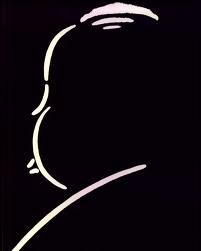
What a daunting challenge this biopic must have presented for an actor! Just being Alfred Hitchcock was a full-time job. Apart from his status as one of cinemas great auteurs, his larger than life-sized personality and all the shopworn anecdotes and pop psychoanalyzing, his instantly recognizable image and profile made this a hard-sell for us going in.
But we were pleasantly surprised. Unlike his campy Richard Nixon for Oliver Stone, Anthony Hopkins had us hooked once we got past quibbles that he does not resemble the Master and tuned into the story about a famous and successful artist hemmed in by advancing age and poor health and others’ professional expectations of him, and about his wife, a gifted and formidable behind-the-scenes presence. Pairing Hopkins's Alfred with Helen Mirren’s Alma was a stroke of inspiration.
Helen Mirren as Alma Reville and Anthony Hopkins as Alfred Hitchcock editing Psycho in Hitchcock.
In addition to the making of Psycho, we see the portrait of a marriage of a couple who has been working together professionally since the mid-1920s. Gervasi and McLaughlin give Alma the full credit Hitchcock never failed to give her but that the public seldom saw. They also show the controlling Hitchcock’s jealous resentment of Alma working independently to help fictional screenwriter Whitfield Cook (Danny Huston) develop a marketable script.
One wonders how the ‘controlling Hitchcock’ himself would have made such a story convincing. How about hiring two senior stars of great ability and charisma and encouraging the second lead to steal the picture from the first?
Gervasi and McLaughlin frame their story within the format of the popular Alfred Hitchcock Hour television series which was current during the making of Psycho. These delicious, hour-long tales of the macabre opened by pairing a taste of the drama to follow with one of Hitchcock’s ironical comments and closed in a similarly amusing, irreverent vein. In this instance, at the end, a raven lands on Hitchcock’s shoulder foreshadowing his next project, The Birds.  
In a sense, what Gervasi and McLaughlin have accomplished is a kind of narrative jujitsu, by taking Rebello’s factual potboiler, Hitchcock-style, and practicing their company’s technical and artistic strengths to show Hitchcock and his company at work rather than to try to ‘give’ us Hitchcock. The rest of their casting is of the same order as the two leads.
In Psycho, Janet Leigh played Marion Crane, with Vera Miles as her sister Lila and John Gavin as Loomis. Anthony Perkins was Norman Bates.
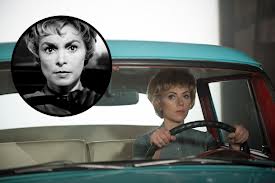
Janet Leigh, inset, and Scarlett Johansson as Leigh playing Marion Crane in Hitchcock.
Scarlett Johansson makes a terrific Leigh and Jessica Biel makes as good a Miles because what we see is Hollywood professionals working as Hollywood professionals, rather than trying to be ‘personalities’ (e.g., Marilyn Monroe, Elizabeth Taylor). James D’Arcy’s Tony Perkins looks and feels startlingly close to the original.
We also see Hitchcock’s team: his MCA (Music Corporation of America) agent Lew Wasserman (Michael Stuhlberg); Peggy Robertson (Toni Collette), his production assistant and gatekeeper; Joseph Stefano, the screenwriter of Psycho (Ralph Macchio); assistant director Hilton Green (Kai Lennox), Saul Bass, Hitchcock’s graphic designer and storyboard artist (Wallace Langham), Bernard Herrmann (Paul Schackman), and film editor George Tomasini (Spencer Garrett), among many others.  
Not least can one imagine Hitchcock and Alma approving Gervasi’s production design and sets (Judy Becker, production designer; Robert Gould, set decorator; and art director Alexander Wei), camerawork (Jeff Cronenweth), and editing (Pamela Martin). The costumes (designed by Julie Weiss), particularly the women’s suits, outfits and lingerie are sublime.
We found this to be a fully satisfying and entertaining hour-and-a-half in the dark with strangers. 

Tuesday, December 18, 2012

Outrageous fortune


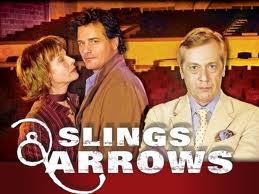
A complicated triangle: Martha Burns, Paul Gross and Stephen Ouimette in Slings & Arrows
Slings & Arrows 2003-6 Canada (three six-episode seasons) directed by Peter Wellington; created and written by Susan Coyne, Bob Martin, and Mark McKinney, with Tecca Crosby and Sean Reycraft.
This gem of a Canadian workplace comedy/drama television series set amid a fictional theater festival is about miracles.
Shakespeare’s words are the first miracle. The next comes when a motley and diverse collection of actors herded catlike together animate these words to enchant the easily distracted modern ear four centuries later.
The third miracle is the terrific series writing and richness of carefully selected detail which together, like good acting, make the careful thought, discernment, talent and hard work that went into the making seem arbitrary and incidental, that is, natural, as though of real life, and not just the cut and thrust of costumed capering.
In a sense, this is a workplace comedy that makes the most frivolous things serious and handles serious matters with a light, sure touch. Unlike most workplaces, the theater provides the broadest context because it involves men and women of all ages across the whole range of human experience.
At the same time, there is a Canadian thing going on: the word ‘sorry’ seems to be a national institution—or to stand for one.
As in Shakespeare’s dramas, the series includes a disparate collection of kings and queens, princesses and paupers, knights and knaves, rogues, fools, fairies, witches, and ghosts. The cast does as good a job in their roles as contemporary actors as the characters they play find voices for Shakespeare’s classic parts.
Alas! Poor Oliver. Paul Gross in Slings & Arrows: the answer is 'To be.' 
It is exciting to watch Shakespeare’s plays take shape from a director’s vision, and to hear the old words in dog-eared scripts find life anew as they have for hundreds of years.
The setting is the New Burbage Festival, a fictional annual theater festival in a small Ontario town, based loosely on the world-renowned Stratford Festival in Stratford, Ontario.
The series may be best characterized as a three-tiered wedding cake with three figures on top, ornately decorated with a profusion of subplots and moments.
The three cake tiers are the Shakespeare plays that lead each festival—and series—season: Hamlet, Macbeth and King Lear.
The figures on top are the story’s three principal roles which form a complicated triangle: Geoffrey Tennant (Paul Gross), the festival’s brilliant and passionate artistic director; Ellen Fanshawe (Martha Burns), the polymorphously perverse main leading lady (as Titania, Gertrude, Lady Macbeth and Regan); and Oliver Welles (Stephen Ouimette), their former director and mentor, untimely done in by a truck bearing the slogan ‘Canada’s Best Hams.’
Oliver’s demise early in season one leads to Geoffrey succeeding him as artistic director. Geoffrey must direct Hamlet, the play in which seven years earlier under Oliver’s direction (and in which Ellen played Ophelia), provoked by Oliver’s manipulations, he had a nervous breakdown during a live production, which ended in a long spell of clinical institutionalization.
Chatty ghost Stephen Ouimette with Paul Gross in season one of Slings & Arrows
Like Hamlet, Geoffrey must master his indecision to act to oppose the ‘sea of troubles’ by which he is beset: a lead played by Jack Crew (Luke Kirby), an American action movie star whose agent sent him to the festival for stage seasoning, as capable of the role as he is intimidated by it; an appallingly bad Ophelia played with ‘Vietnam flashbacks’ by Claire Donner (Sabrina Grdevich); and most of all his ‘theatre father’ Oliver’s ever-present, kibitzing ghost. An inspired understudy played by Rachel McAdams and a chameleon turn out to be the silver lining.
Geoffrey also must contend throughout the series with the suits, particularly the festival’s musical-happy executive director Richard Smith-Jones (Mark McKinney, one of the series writers). Anna Conroy (series creator and writer Susan Coyne), Richard’s straight-faced associate administrative director, strains a Canadian stiff upper lip to contain this antic hay.
Susan Coyne and Mark McKinney, writers and stars of Sling & Arrows
One of many lively subplots involves Richard and Holly Day (Jennifer Irwin), an effervescently over-the-top representative of the festival’s new American corporate sponsor from Houston—a classic Canadian take on the neighbors across Niagara Falls.
Season two features Henry Breedlove (Geraint Wyn Davies), a pompous, square-jawed veteran stage actor, as Macbeth, in a power struggle with Geoffrey as his director, complete with echoes of Sergio Leone theme music.
Alongside this battle royal runs Romeo and Juliet, directed by the flamboyantly condescending, beleathered Darren Nichols (Don McKellar) with exuberant affection for Germanic and special effects. Nichols is at pains to contain his Patrick (David Alpay) and Sarah (Joanne Kelly) whose Romeo and Juliet take on lives of their own and burst from the postmodern cages in which he purports disdainfully to mock them.
Joanne Kelly and David Alpay as Juliet and Romeo caged in Slings & Arrows
Watching Patrick and Sarah play Romeo and Juliet’s famous night together (II, ii) from the wings, Ellen, who once played Juliet to Geoffrey’s Romeo, tells Geoffrey that she hates the play.
‘You watch it and you feel miserable because you don’t have that kind of passion in your life. Nobody does. It’s a fantasy. It’s irresponsible,’ Ellen says.
‘You know what I think?’ Geoffrey replies. ‘I think it’s painfully accurate. Two idiots meet, they fall in love; they’re happy briefly; then all hell breaks loose. Happens all the time.’
Meanwhile in a contemporary theatre workshop, two more ‘idiots,’ playwright Lionel Train (Jonathan Crombie) and practical Anna, develop a mad passion.
Paul Gross, William Hutt and Sarah Polley rehearsing King Lear in Slings & Arrows
Season three features elderly stage legend Charles Kingman (the octogenarian Shakespearean actor William Hutt) as King Lear, relentlessly hectoring his Cordelia, Sophie Dunbar (actor, writer and film director Sarah Polley). The counterpoint to Hutt's spellbinding pièce de theatre is a fizzy contemporary Broadway-style musical East Hastings: the Musical that puts a bounce in Richard-the-suit’s middle-aged step.
The series makes delicious mincemeat of theater people, those who make theater no less than their audience and supporters. No sweat there. One of the reasons it works well is the sense that these writers and actors make fun of the theater people they know best: themselves and each other. The parody is entirely within scale. The cast play roles and tell stories larger than life; thus the drama and parody need be larger than life-sized.
We see actors living the same rambling, shambling passionate lives offstage as they play on it. The Shakespeare snippets are done convincingly well—or badly on purpose; the fragments of Hutt’s King Lear are astounding.
The great moments surprise and delight. One comes in the bar where the actors hang out, after the festival cancels King Lear. Cyril (Graham Harley) and Frank (Michael Polley, Sarah’s father), an older gay couple who play perennial roles ‘in the middle of the pack,’ try to console disappointed Sophie that the cancellation is not the end of the world.
‘Oh Sophie, love, don’t fret. You’ve got lots of talent, you’ll have loads of success and a very long career,’ said Cyril.
‘But… at the end of it all, you’ve got to have some spectacular cock-ups,’ Frank said.
‘Because then you’ll have stories,’ Cyril said.
‘And then, you’ve had a life… You’ve had a life,’ Frank said.

The show does indeed go on—and ends with a wedding.

Tuesday, November 27, 2012

Winging it


Ricky 2010 France (89 minutes) written and directed by François Ozon.
This movie adapts a dark modern fairy tale by Rose Tremain that adds a dimension to the concept of a child ‘taking off’ at the mall, losing its original edge in a fruitier cocktail.
Tremain’s story, Moth, set in an American trailer park, centers on the emotionally overtaxed, separated mother of two with a difficult infant who develops an unsettling physical feature, and the consequences of this development. It has a sharp, cruel ending, not unlike some of the Grimms’ tales.
Ozon and his writing collaborator Emmanuèle Bernheim refashioned and padded Tremain’s sparer original American Calvinist hardwood furniture, moving it to France and making it more Roman Catholic and rococo.
The movie generally follows the story’s plot lines, but the changes make the tale wobble. The main problem is that the central role of the mother as Ozon and Bernheim conceive her—the actress is just following a script and direction—makes for a squishy center, too wishy-washy as a character to hold the story together. In the short story, the mother has a brittle toughness that snaps, where in the movie she just flakes away.
The film is worth seeing nevertheless.
Ozon sets the table by opening his story with a scene from the middle, in which a social worker counsels an abandoned working mother at the end of her tether with a small child and difficult baby. His narrative then proceeds chronologically from the beginning, roughly a year earlier. It moves in episodes, covering a period of about two years in a loose sequence of scenes. An all-seeing camera is his narrator.
The working mother is Katie (Alexandra Lamy), a factory worker, who begins the story a single mother leading a quiet life in a French high-rise housing project with her seven-year-old daughter Lisa (Mélusine Mayance, the child Sarah in Sarah’s Key 2012).
One day at work Katie has sex in a restroom with a new coworker, Paco Sanchez (Sergi Lopez, the cruel stepfather in Pan’s Labyrinth)—a random sexual encounter that seems unlikely for a stressed-out mother on a smoke break at work. This liaison leads to a relationship in which Paco moves in with Katie and Lisa; he and Katie produce the Ricky of the title.
Daughter Lisa is responsible beyond her young years. Her ‘objections’ to her ‘new father’ feel more like adult misgivings about Katie’s judgment than any resentment at being ‘replaced’ in her mother’s affection. Lisa as though resigns herself to the fact: all right, now I have two of these monsters to deal with—Ab-Fab, French style.
Along comes Ricky (Arthur Peyret). Katie as though awakens and scales untold heights of protective mothering which result in driving Paco away. Ricky develops his ‘unsettling physical feature.’ Katie gives the thing a stab but clearly is out of her depth. Ricky provides Lisa, with her little pink fairy wings, tiara and wand, something decidedly more interesting to take care of than her doll.
The little family’s secret flies the coop in an inspired scene at a big box Hypermarché Cora at Christmas time. (In Tremain’s story, this scene takes place in a more prosaic Kroger’s grocery store in Knoxville, Tennessee.)
A media circus ensues; a hang-dog Paco returns with gently-used mixed motives; none of this lasts long. Ricky takes off; Paco stays.
Then Katie, possibly intending to drown herself (as does the mother in the short story), has a Bergmanesque medieval ‘vision’ at the lake—or else a kind of rococo Annunciation. She returns home renewed and inspired to start over, all wet and flakier than ever, to Paco, who-only-ever-wanted-things-to-work-out-all-right-after-all, and Lisa, concerned as before about Mom’s woolly judgment.
Life goes on. Paco assumes Katie’s parenting duties. Katie is pregnant again, this time with a thousand-mile gaze and a New Age smile awaiting the Second Coming. And the audience is left trying to iron all these wrinkles into continuous narrative pleats.
But Ozon’s version is worth seeing, especially the scene at the big box store and Katie’s lakeside vision. Ricky and his ‘special feature,’ and Lisa, are the film’s best made parts, along with the haunting original score composed, arranged and directed by Philippe Rombi, who also played the piano solos.
Tremain’s title, Moth, refers in part to Ricky’s attraction to light. Light also attracts Ozon’s Ricky, but as a real baby with a human face and personality he feels like a more evolved legendary creature than the fabulous figure of the story. Ozon’s Ricky is less a moth to light than a form of New Age Ikaros.
MP encourages readers to find Tremain’s short story in her 2005 collection, The Darkness of Wallis Simpson. In the remarkable title story, the longest of the dozen, the dying, senile Duchess of Windsor searches her colorful, passionate history unable to name ‘the pale little man’ that so often turns up in the background. 
In contrast to Ozon’s camera, the narrator of Tremain’s Moth is Annie, a friend and trailer park neighbor of Pete, the baby’s mother.
Annie is a middle-aged working class woman whom nothing particularly fazes. She speaks in flat folk tones that alternate between irony and self-deprecation about what she saw, as though to say, ‘Now you may not buy this, but I am here to tell you what I saw with my own two eyes.’
The children have the same names. Annie tells us that Pete supports the family by making appliqué items she sells at a craft venue through a ‘hippie’ with whom she has a ‘Platonic relationship.’ Chester, the father of both children, is a Joycean Cyclops, an abusive, overweight fireman ‘with a big appetite’ who leaves Pete for a woman half his age. He comes back in the midst of the media circus to cash in on the baby, and then disappears.
Tremain’s tale comes to a dark end. Pete’s sewing machine, the source of her livelihood, becomes the instrument of her destruction.
Annie does not ask questions while the story unfolds, so all we have is her word via Tremain’s able craft and our imaginations.
Ozon’s main challenge was that his silent, all-seeing narrator had to resolve the questions Annie did not ask in order to fabulize this fairy tale into pictures. The central conceit still requires an audience to suspend disbelief. But unlike a DreamWorks extravaganza, for instance, Ozon’s sophisticated technical wizardry brings off what is essentially a discreet domestic story.