
 |
|
“Are you afraid of offending me by not agreeing with what I say?” Doctor D (James Earl Jones) in Aram Avakian’s End of the Road. |
 |
|
Spin-the-bottle with a Colt .45? US social and political idiosyncrasies’ odd staying power. |
 |
|
Who you gonna call? The “culture war” circa 1968: incidental sticker on a pay telephone. |
 |
|
“It is required of a man, that he should share the passion and action of his time” Robert F. Kennedy |
 |
|
Strangers in a strange land: Doctor D (James Earl Jones) approaches a “catatonic” Jacob Horner (Stacy Keach) at Penn Station in Baltimore (actually a SEPTA station on the Philadelphia Main Line). |
 |
|
“Forgotten Ones” frolic on the grounds of Doctor D’s Remobilization Farm in Aram Avakian’s End of the Road. |
 |
|
“No, no: it is not real. Cause perhaps but no effect. Doing his own thing.” Doctor D on patient Sniperman (Ray Brock) in Remobilization Farm’s “protective condition of controlled reality”. |
 |
|
Professor Joe Morgan (Harris Yulin), a radical subjectivist and eternal Boy Scout: “No sense in apologizing. Ultimately nothing is defensible.” |
 |
|
“Real people don’t behave any differently when they’re alone”—Rennie Morgan (Dorothy Tristan).“Horsecrap! Nobody’s real”—Jacob Horner (Stacy Keach) |
 |
|
“A path should be laid out where people walk, instead of walking where paths are laid” Joe Morgan (Harris Yulin) in Aram Avakian’s End of the Road. |
 |
|
Jacob Horner (Stacy Keach) in Doctor D’s (James Earl Jones) Progress and Advice Room. |
 |
|
“The strategy of protecting the ego by myth-making and role-assigning is called mythotherapy” —Doctor D (James Earl Jones) to Jacob Horner (Stacy Keach) |
The film’s final credits run over images and clips of the Apollo 11 moon mission with Billie Holiday’s version of the Rube Bloom and Ted Koehler’s “Don't Worry ‘bout Me”.
That used to be?
If you can’t forget, don’t worry ‘bout me.”
End of the Road 1970 U.S. (110 minutes) Max L. Raab Productions/Allied Artists; directed by Aram Avakian; screenplay by Avakian, Dennis McGuire, and Terry Southern from the novel by John Barth; cinematography by Gordon Willis; editing by Robert Q. Lovett; music by Teo Macero; produced by Stephen F. Kesten and Terry Southern.
 |
|
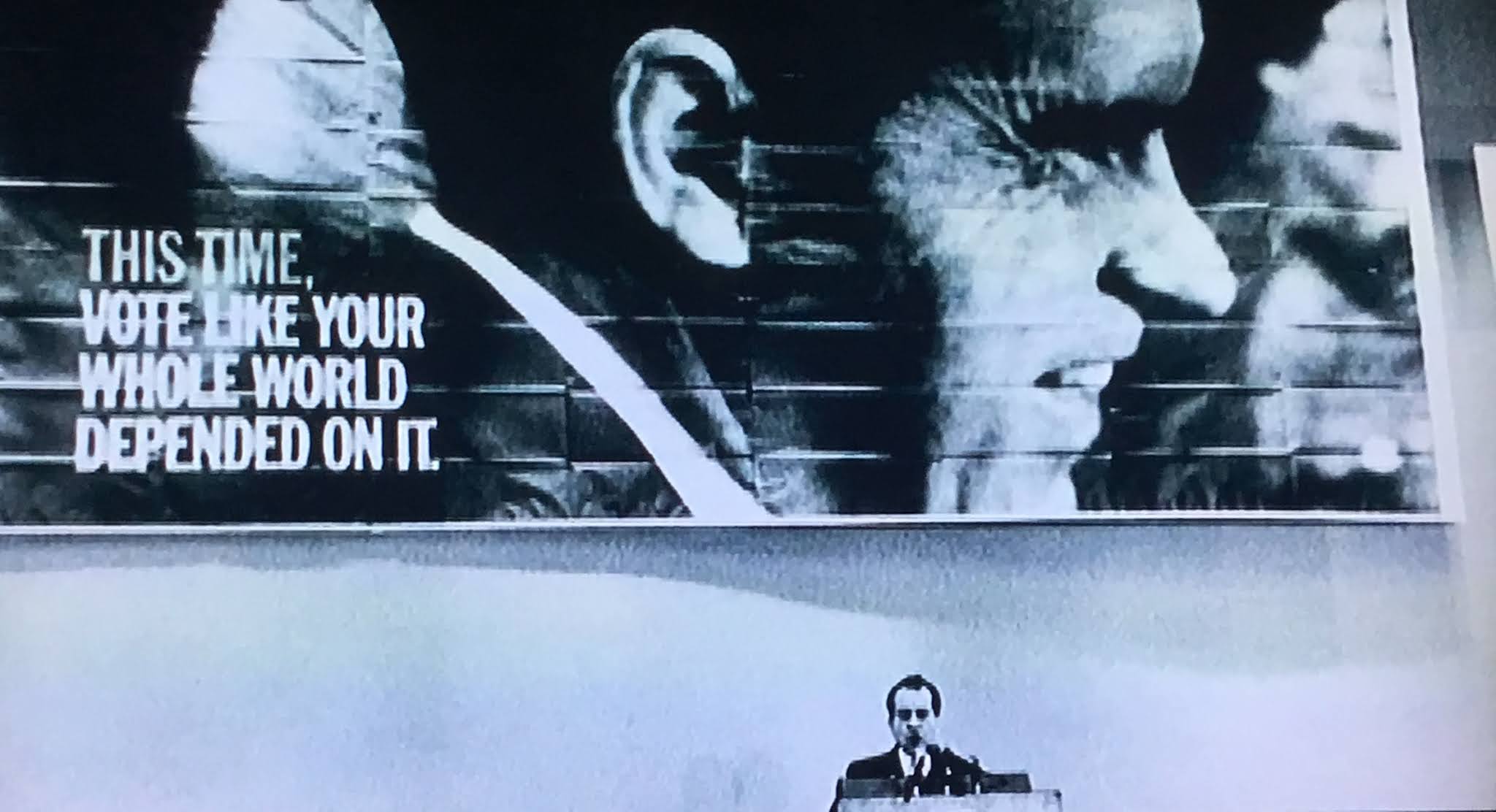
Aram Avakian’s End of the Road features period photomontages with images such as this photo from Richard M. Nixon’s 1968 presidential campaign. |


