Tuesday, August 16, 2022

Jańcio Wodnik/Johnny Aquarius

This story from newly post-Communist rural Poland has elements of Polish and Yiddish folklore, as though a reverie by an older, dottier, gentile Tevye.

The fate of a horse found by a homeless Dziad [“old timer”] (Olgierd Łukaszewicz), frames the main narrative of Jan Jakub Kolski’s 1993 Jańcio Wodnik/Johnny Aquarius.

The framing story involves a horse. A homeless wanderer, Dziad [“Old timer”] (
Olgierd Łukaszewicz), happens upon a mare on a rural path. Beholding an answered prayer, Dziad approaches the horse reverently; and then she drops dead. He buries her. “For wasting a horse, I hope a devil is born among you!” he says.

Jańcio (Franciszek Pieczka) sits with his young wife Weronka (Grażyna Błęcka-Kolska) as he considers his holy mission in Jan Jakub Kolski’s 1993 Jańcio Wodnik/Johnny Aquarius.

The story’s protagonist J
ańcio (Franciszek Pieczka), an old peasant, relates this story to his young wife Weronka (Grażyna Błęcka-Kolska). Jańcio cannot believe that anyone would turn a horse out like that, worn out and with water running from under her tail. And at the end, Jańcio blames Socha (Lech Gwit), the horse’s former owner, for the unusual events he brought about by turning the horse out.

Water dumped in a farmyard becomes “żywa woda”, living water that climbs a ladder to fill a bird’s nest in Jan Jakub Kolski’s 1993 Jańcio Wodnik/Johnny Aquarius.

Within this frame is J
ańcio’s rags-to-riches-to-rags tale as a miracle-working washer of feet. Jańcio is astonished when water from his own foot-washing, and then Weronka’s, thrown into their yard, climbs a ladder, “żywa woda” [living water] as though a kind of mayim chayim. He cannot turn water into wine. But he has visions; he begins to speak in Gospelic platitudes and after a long ponder he and Weronka agree that he must share his gift, such as it may be, with the wide world that is their native Brzustowa and the surrounding area in north-central Poland. Jańcio leaves behind his pregnant wife, setting out with his rustic wooden beczka strapped to his back, sloshing water—Jańcio Wodnik—Johnny the Water-bearer.

Jańcio (Franciszek Pieczka) revives Józek (Wiesław Cichy) in Jan Jakub Kolski’s 1993 Jańcio Wodnik/Johnny Aquarius.

Lightning from a storm that J
ańcio believes his new powers caused strikes Józek (Wiesław Cichy), a man in a nearby village, while riding a horse “standing up like a cavalier”. Peasants have buried the “Umarlak” [goner] up to the neck in hopes of reviving him. Jańcio requests that the peasants dig him up; he washes Józek’s feet, and the “goner” awakes. Jańcio is rewarded for this “miracle”; his career is set. He cures the blindness of a young woman, Oczyszczona (Katarzyna Aleksandrowic). He falls in with Stygma (Bogusław Linda), a motorcycle-riding charlatan stygmatic who performs as one marked by the hand of God—with an eye for attractive village women. Stygma eventually “manages” Jańcio’s income and growing entourage.

Jańcio (Franciszek Pieczka) falls in with Stygma (Bogusław Linda), a motorcycle-riding charlatan stygmatic in Jan Jakub Kolski’s 1993 Jańcio Wodnik/Johnny Aquarius.

Weronka’s baby is born with a tail. People suspect a sign of the devil. Weronka brings the baby to J
ańcio but his inability to make his tail go away convinces Jańcio’s followers that he has lost his power. They send him home. He sits in his farmyard for five and a half years trying to “turn back time” to recover his and his wife’s lost love, setting up the conclusion of the story.

Jańcio’s (Franciszek Pieczka) success as a folk healer brings gifts and a following in Jan Jakub Kolski’s 1993 Jańcio Wodnik/Johnny Aquarius.

The story is told like a folktale, the film shot in a nearly-documentary style in which scenes take no longer than necessary to register and convey essential elements of the narrative. One senses a playful verbal humor that requires fluent Polish and a good grounding in Polish Catholicism to follow. Zygmunt Konieczny wrote the music and ballads; the ballad lyrics were written by the director and sung by Błęcka-Kolska, Elżbieta Dębska, and Tadeus Zięba.

Jańcio (Franciszek Pieczka) uses his son’s tail to brush off his jacket in Jan Jakub Kolski’s 1993 Jańcio Wodnik/Johnny Aquarius.

The entire film is available to be streamed.
 

Jańcio Wodnik (Johnny Waterman/Johnny Aquarius) 1993 Poland (101 minutes) Telewizja Polska/Vacek Film. Directed, with script and dialogue by Jan Jakub Kolski; music by Zygmunt Konieczny; screenplay by Tadeusz Kosarewicz; cinematography by Piotr Lenar; edited by Ewa Pakulska; costumes by Beata Olszewska; production design by Tadeusz Kosarewicz; produced by Andrzej Stachecki.

Thursday, August 11, 2022

A marvel, classic

Jason Bourne in a contractor’s ballcap in France and the plot squib of Stillwater (2021) primed MP for a Taken clone to avoid when the film came out last year.

We could not have been more mistaken. This thoughtful, understated piece adds an international dimension to the body of work by Tom McCarthy, best known for directing and co-writing the Academy Award-acclaimed Spotlight (2015) about The Boston Globe breaking the story of pedophile Roman Catholic priests.

Often in McCarthy’s stories, damaged, isolated characters discover resonances in others outwardly different or estranged from them. The characters’ damage and isolation arise less from specific traumas than patterns worn from living their lives. They do this memorably in The Station Agent (2003), The Visitor (2007), Win Win (2011), and here in Stillwater. The films work well because their outwardly mismatched casts, here led by Matt Damon, Abigail Breslin, and Camille Cottin (of Call My Agent!/Dix pour cent 2015-20), gel as ensembles to produce a satisfying range of tones which complete an idea of something believable.

No one figured Bill Baker (Damon) to amount to much, especially not himself, in Tom McCarthy’s Stillwater (2021).

Bill Baker (Damon) is less than a Midwestern Everyman. A high-school dropout, he never did much with his life but “make holes” as an Oklahoma oilfield roughneck. Nor did anyone expect him to, starting with himself, “working oil rigs, being a fuck-up when I wasn’t.” After his wife killed herself young, his mother-in-law Sharon (Deanna Dunagan) took over raising his daughter. Bill drank and did prison time for assault. He stopped drinking and found Jesus where he left him. Laid off from his oil rig job, he works “construction” as a day laborer with recent immigrants clearing tornado-devastated houses.

Straight-talking, no-nonsense “Gram” Sharon (Deanna Dunagan) took over raising Bill’s daughter Allison after his wife’s suicide.

Bill’s daughter Allison, a student at Oklahoma State University in hometown Stillwater, got into a study-abroad program at Aix-Marseille University in France, “
far away and completely different” from home. However, an affair with a French Algerian woman student soured. Allison’s live-in lover was murdered. Allison, convicted for the crime, got a nine-year sentence. Straight-talking, no-nonsense “Gram” Sharon handled the French lawyer and the money. She attended Allison’s trial in Marseille and visited her in prison until her health made it difficult and Bill took over.

Bill (Matt Damon) visits his daughter Allison (Abigail Breslin) in prison in Marseille in Stillwater (2021).

We first meet Ally (Breslin) when Bill visits her in Marseille five years into her sentence. Ally is happy to see a familiar face she can trust, though mainly relieved that “Dad” will take a letter to her lawyer. The letter is written in French: Bill cannot read it. He and his daughter are not close. For Bill, a two-week trip to Marseille to visit Ally could just as well be to a remote prison in the US or anywhere. It’s a duty. He brings Gram’s gifts and does a load of laundry. Bill prefers Subway to bouillabaisse: he does his duty, gets by with the French, goes home when it’s over. He takes the letter to Ally’s lawyer Ma
ître Leparq (Anne Le Ny).

For Bill (Matt Damon) a two-week trip to Marseille to visit his daughter is a duty that might as well be to a remote prison somewhere in the US.

In a sense, Bill is like an American GI of the so-called Greatest Generation, or how Americans now like to think of them, whom Europeans met during the war: na
ïve, but a bit older. Like the GIs, Bill knows practically nothing of the world outside his hometown; he accepts that life elsewhere is different. He and the GIs share the saving grace of recognizing that people are people wherever they go, despite looks, language, or politics: rather than worry about what they don’t get, they touch similarities. As such, the film’s focus remains on individual characters without political or “culture war” comment. Bill knows “acceptance”: he takes people in his steady gaze at face value and gets along fine with most of those he meets, especially children.

Bill (Matt Damon), who takes people at face value, meets Maya (Lilou Siauvaud) and through her finds a helper in her mother Virginie.

Through a small child, Maya (Lilou Siauvaud), Bill finds an ostensibly unlikely helper in her mother Virginie (Cottin), a younger almost-hip French theatre actress and single mother. Bill extends his stay in Marseille. Ally’s letter to her lawyer, along with Maya and Virginie’s entrance into the story, organize a collection of possibilities which comfortably hold a viewer’s interest for the film’s slightly longer than two-hour running time.

Bill (Matt Damon) follows a lead to clear his daughter Allison of a murder conviction with the help of Virginie (Camille Cottin).

In addition to soft-pedaling politics and culture war,
Stillwater is notable for entering the French world with an open eye and ear. Half the four-man writing team is French. The film gets authentic context watching and listening to the French eat and talk, whether among cops in a Vietnamese restaurant, a group of friends dining on a terrace, or Virginie and her friends at home. Another part of the story shown rather than told is Marseille’s unique character as an ancient port city, perhaps not unlike New Orleans in the US.

Eating and talking: Stillwater (2021) is notable in that it enters the French world with an open eye and ear, watching and listening to the French do two things they like best.

L
ife portrayed in Stillwater may be only as brutal as it needs to be. Bill Baker dressed in plainness and an oil rig contractor’s ballcap in France summons his best to find a way to get his daughter out of a foreign prison and in doing so finds himself.

Stillwater 2021 U.S. (139 minutes) Participant/Dreamworks/Focus Features. Directed by Tom McCarthy; written by McCarthy, Marcus Hinchey, Thomas Bidegain and Noé Debré; music by Mychael Danna; cinematography by Masanobu Takayanagi; editing by Tom McArdle; casting by Kerry Barden, Anne Fremiot, Paul Schnee; production design by Philip Messina; produced by McCarthy, Liza Chasin, Steve Golin, Jonathan King.

Saturday, May 28, 2022

Under Capricorn

Alfred Hitchcock’s Under Capricorn (1949) is unusual in his work in that the mystery at its center is a presumed marital mismatch.

Bright colors: Michael Wilding and Ingrid Bergman in Alfred Hitchcock's Georgian costume melodrama Under Capricorn (1949).

A
udiences didn’t go for it. Rather than corpses, shadows, and ironic jeux d’images, the film is a bright costume melodrama told in long takes that feature dialogue and acting; it is in Technicolor (Rope the year before was Hitchcock’s first); and it is set in Australia long before Australia was “cool”. Imagine a later Douglas Sirk or Vincente Minelli picture without the elaborate Hollywood studio sets (Hitchcock shot Under Capricorn in MGM British Studios in postwar England), and without Hitchcock’s characteristic expressionist vocabulary, lighting, and camerawork. It’s just not what Hitchcock does!

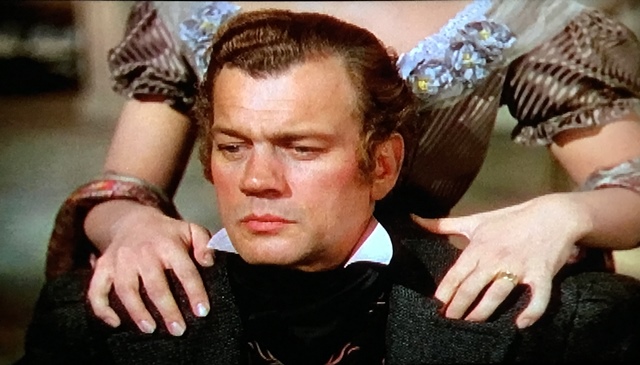
Mr. Flusky (Joseph Cotten) and his wife are unambiguous in their feelings toward one another while others follow their prejudices in Alfred Hitchcock’s Under Capricorn (1949).

In this story, a marriage of social unequals stands in for criminal mischief. But no less than in Hitchcock’s murder mysteries, society looks where its prejudices point rather than at where the evidence leads. Sam Flusky (Joseph Cotten) is a self-made colonial landowner, a former convict transported from Ireland; his wife Henrietta [Hettie] Considine (Ingrid Bergman) is his former Irish master’s daughter. As far as the British class system goes, society’s doors are closed to this couple and apart from colorful gossip no more need be said of their ill-favored match.

Millie and Danny: Margaret Leighton’s Millie in Hitchcock’s Under Capricorn (1949) recalls Judith Anderson’s Mrs. Danvers a decade before in Rebecca.

Under Capricorn
’s plot recalls Hitchcock’s Rebecca (1940) with its malevolent “Danny” Danvers devoted to her mistress. Here Flusky’s housekeeper Millie (Margaret Leighton), operating as mistress of his house and nurse of madame, is unrequitedly devoted to Flusky. By the way, Bergman was the one originally “gaslighted” in George Cukor’s famous 1944 film; Cotten was the cop.

The new governor (Cecil Parker) arrives in Sydney, New South Wales, in Alfred Hitchcock’s Under Capricorn (1949).

The story opens with the arrival in 1831 Sydney, New South Wales, of the colony’s new governor (Cecil Parker) accompanied by his younger second cousin Charles Adare (Michael Wilding). Adare, an Anglo-Irish dandy, has little going for him professionally or financially, besides his sense of entitlement. In short order he meets the gruff Flusky. Each from the west of Ireland senses a “bumping into bygones” with a dim, long-ago recognition of the other’s name. Intrigued by the social reputation and gossip surrounding Flusky, Adare accepts his invitation to dine at his home despite several warnings—and his cousin’s orders.

Hitchcock’s camera approaches and explores the Flusky household in a ten-minute take in Under Capricorn (1949), the second color film in which he experimented with the technique.

The audience is introduced to the Flusky household in the evening from Adare’s point of view in a ten-minute take (TMT). This is a single continuous shot made using a complete reel of 35mm sound film (at a standard length of 1000ft/305m at 24 frames per second, this runs actually about 11 minutes). Hitchcock experimented with this technique in Rope the year before, an 80-minute film composed almost entirely of TMTs spliced literally back-to-back. In this TMT, the camera tracks Adare’s approach to the front door of the Flusky house; and then outside the house looking in from the veranda, following inside voices to activity in the kitchen; it then follows Adare into the kitchen to meet Flusky, Millie, and Flusky’s secretary Winter (Jack Watling); and then Flusky brings Adare back through the inside of the house Adare has just surveilled from the veranda to a reception room where he is introduced to the other dinner guests making apologies for their wives; the camera follows this group to the dinner table. The TMT ends after Mrs. Flusky appears unannounced and takes a seat at the table. Adare—and the audience—have the complete picture.

What sweeter, more irresistible music than a damsel in distress? Ingrid Bergman and Michael Wilding in Alfred Hitchcock’s Under Capricorn.

Mrs. Flusky appears in turn lovely, watchful, alarmed, nervous, self-involved, distracted, pathetic: the full range of faces and feelings a masterful actor like Bergman projects to capture viewers no less than the narrative point of view. What sweeter, more irresistible music can there be to a Shelleyan soul like Adare than a damsel in distress, better yet a former genteel acquaintance?

Hettie Flusky’s reflection is Ingrid Bergman’s extraordinary face in an impromptu mirror in Alfred Hitchcock’s Under Capricorn (1949).

Viewers see Under Capricorn’s dénouement through Hettie Flusky’s (Ingrid Bergman) eyes.

The visual storytelling in long takes focuses on Bergman’s extraordinary face and gestures. This is where the viewer must pay the closest attention, where most of the “evidence” is revealed. Alone and with others, husband and wife are unambiguous in their feelings toward one another throughout the narrative while other characters see what they want or think they are supposed to see. The rest of this often overlooked work we shall leave to the viewer to see.

No Hitchcock film is complete without a Real MacGuffin—a shrunken head rolls around in Under Capricorn (1949).

Under Capricorn 1949 U.K. (118 minutes) Transatlantic Pictures; Warner Brothers. Directed and produced by Alfred Hitchcock; screenplay by James Bridie, adapted by Hume Cronyn from the novel by Helen Simpson; cinematography by Jack Cardiff; editing by A. S. Bates; music by Richard Addinsell and Louis Levy; costumes by Roger Furse.

Saturday, May 21, 2022

Teenage Wasteland

There is no place like high school where adults pretzel acts of teenage disobedience into disciplinary offenses with serious consequences.

Erik Babinsky (Jonas Dassler), Theo Lemke (Leonard Scheicher), Lena (Lena Klenke), Paul (Isaiah Michalski), Kurt Wächter (Tom Gramenz), and twins Klara and Regina Winkler (Nele and Nora Labisch) in class.

The high schoolers in Lars Kraumer’s The Silent Revolution (Das schweigende Klassenzimmer-2018) are not unlike their roughly contemporary peers in Peter Weir’s The Dead Poet’s Society (1989), only the stakes are much higher. Kraumer’s narrative, based on an actual story, is set in Stalinstadt, a postwar socialist showplace (now Eisenhüttenstadt) in Cold War East Germany. 
 
The action opens in November of 1956, five years before The Wall went up in Berlin. Kurt Wächter (Tom Gramenz) and Theo Lemke (Leonard Scheicher) are high school seniors and best friends. They lark over to the American Sector in Berlin on the pretext of visiting Kurt’s grandfather’s grave to see Liane, das Mädchen aus dem Urwald [Liana, Jungle Goddess] (1956) a movie notorious in its day for featuring a titillatingy topless teengirl Tarzan. They also see a newsreel reporting the uprising in Budapest, Hungary, against the Soviet occupation.  

In Berlin’s former American sector in November 1956, the boys saw “Liane, Jungle Goddess” along with a newsreel report of Hungarian students and civilians opposing Russian occupation.

Kurt and Theo share the Hungary news with their classmates. A group of them go with their classmate Paul (Isaiah Michalski) to visit Paul’s great uncle. Uncle Edgar (Michael Gwisdek), an elderly freethinker, lives in a tumbledown riverside farm and purportedly listens to RIAS (Rundfunk im amerikanischen Sektor, the US radio station in Berlin during the Cold War). The kids follow Western reports of the Hungarian uprising several nights on RIAS at Uncle Edgar’s. They hear that Hungarian superstar footballer Ferenc Puskás was killed in the fighting. But as teenagers they also dance to Little Richard’s “Tutti Frutti” and other current Western hits. 

Kurt Wächter (Tom Gramenz) tuning in the latest report on the Hungarian Revoluion on RIAS at Uncle Edgar’s in Lars Kraume’s (2018) Das schweigende Klassenzimmer (The Silent Revolution).

Right before Mr. Mosel’s (Rainer Reiners) first-period class the next morning, the kids vote on and agree to an opening two-minute “moment of silence” in sympathy with the Hungarians. These typical high school seniors at first feel strength in their solidarity. There is no question from one to the next that they are “good socialists”. They shoot amused, nervous glances at each other as they sustain their silent protest while Mr. Mosel blows his top in classic German style.  

The class in its moment of silence viewed from the blackboard in Lars Kraume’s (2018) Das schweigende Klassenzimmer (The Silent Revolution).

School principal Schwarz (Florian Lukas) wrestles with how to deal with the incident. He knows and likes these kids and recognizes that kids get up to things. But he is concerned about the political light the incident will put on him when his higher-ups find out. The school’s political officer (Daniel Krauss) reports the incident behind the principal’s back to District School Board Chair Frau Kessler (Jördis Treibel) and then to German Democratic Republic (GDR) Minister of Education Fritz Lange (Burghart Klaussner). Kessler comes first, and then she and Lange appear at the school in a ministerial black limousine to investigate and root out “counterrevolutionary activity”. 

Minister of Education Fritz Lange (Burghart Klaussner) tries to ferret out the "counter-revolutionary activity" from Eric Babinsky (Jonas Dassler) a presumed weak link, with FDJ-Sekretär Lange (Daniel Krause) and District School Board Chair Frau Kessler (Jördis Treibel).

Remember, this is high school girls and boys. This proto-Breakfast Club had parents to deal with. But unlike John Hughes’s Midwestern US suburban 1980s, these parents are raising families in a harshly unforgiving political climate. Stalin died in 1953 but de-Stalinization had yet to get underway. Kurt’s father Hans Wächter (Max Hopp) is chairman of the city council; Kurt’s maternal grandfather killed in the war had served in the Waffen SS. Theo’s father Hermann Lemke (Ronald Zehrfeld) is a steelworker who had an active role in the 1953 East German uprising against the Russians. Paul’s Uncle Edgar is gay and listens to RIAS. Theo’s girlfriend Lena (Lena Klenke) lives with her grandmother (Carmen-Maja Antoni) because her mother emigrated to Denmark. Erik (Jonas Dassler) reveres the beau idéal of his German communist father killed fighting Nazis during the war but lives with his mother (Bettina Hoppe) and stepfather (Götz Schubert), a parish priest. Kurt and Theo’s other dozen classmates have similar backgrounds. 

Hermann Lemke (Ronald Zehrfeld) and Theo (Leonard Scheicher) talk about life as they walk to the steel mill in Lars Kraume’s (2018) Das schweigende Klassenzimmer (The Silent Revolution).

The farther one gets from having been a self-dramatizing teenager can make it easy to forget how serious and self-absorbed we were, our relationships with friends and parents, and the bullies that school authorities can be. This drama rides on the quiver of threats authorities wield to turn or break the kids, and whether they—and their parents—stick up for one another together. In the Stasi conception of Marxist-Leninist “criticism and self-criticism”, everyone is compromised and there is zero incentive for a principled individual act. Kraume and his cast make this piece visceral, particularly in the person of Treibel’s Frau Kessler.  

District School Board Chair Frau Kessler (Jördis Treibel) turns up the volume to find answers in Lars Kraume’s (2018) Das schweigende Klassenzimmer (The Silent Revolution).

The outcome is worth waiting for. However, apart from the class, Kraume does not disclose how this affected the parents and other adults. 
 
The film was shot on location in Eisenhüttenstadt and Berlin and the sets are superb. The original story is told by Dietrich Garstka, one of the participants, in his book “The Silent Classroom”.  
Author Dietrich Garstka and his classmates, the original class in story behind  Lars Kraume’s 2018 film Das schweigende Klassenzimmer (The Silent Revolution).
Das schweigende Klassenzimmer (The Silent Revolution) 2018 Germany (111 minutes) Akzente Film/StudioCanal. Adapted for the screen and directed by Lars Kraume, based on the book by Dietrich Garstka; cinematography by Jens Harant; edited by Barbara Gies; production design by Olaf Schiefner; casting by Nessie Nesslauer; music by Christophe Kaser and Julian Maas.

Sunday, May 15, 2022

Papa's Words Made Flesh

Casablanca director Michael Curtiz and screenwriter Ranald MacDougall’s The Breaking Point (1950) is notable for giving voice to Ernest Hemingway’s distinctive language and portraying Black characters equal with Whites. 

Notable for the time, first mate Wesley Park (Juano Hernandez) plays a responsible Black equal to protagonist Harry Morgan (John Garfield) in Michael Curtiz’s The Breaking Point (1950).

This is the second Warner Brothers film based on Hemingway’s “To Have and Have Not,” less a novel than a pastiche of stories but the source of a pair of films as good as they are different from each other. 

The Warners’ first crack at the story is one of the great classics of Hollywood’s Golden Age. In the war years, screenwriters Jules Furthman and William Faulkner fashioned it for director Howard Hawks as a star vehicle for Humphrey Bogart and film-newcomer Lauren Bacall. Less concerned with the original story than cool for its day, Bogart’s “Steve” trades double entendres with Bacall’s “Slim”, Water Brennan’s lovable rummy first mate Eddie avoids bee bites, and Hoagy “Cricket” Carmichael takes Dooley “Sam” Wilson’s place at the piano in a drama is set in Vichy-ruled Martinique to get anti-Axis propaganda on the menu.

Hoagy “Cricket” Carmichael and film-newcomer Lauren “Slim” Bacall chew scenery in Warner Brothers’ first cool crack at Ernest Hemingway’s “To Have and Have Not.”

Curtiz and MacDougall’s postwar version used more of Hemingway’s novel but shifted the setting from the Caribbean to the postwar Pacific. Retitled The Breaking Point, the Warners’ second film opens in Newport, California, with its lead John Garfield reading an adaptation of the novel’s first paragraph in a voice-over. This establishes Hemingway’s stylistic cadences and repetitions in a more coherent narrative than the original as the cast navigate a series of Hemingway-like situations. Often mistaken for simplicity, Hemingway’s modernist style is easier to parody than copy. MacDougall has done a remarkable job adapting it for the screen.

John Garfield’s look and his characters’ attitudes made him an ideal Everyman for 1940s filmgoers.

Garfield’s Harry Morgan is one of his best roles and among the most authentic Hemingway characters on film. His look and his character’s attitudes made him an ideal Everyman for 1940s filmgoers the way Hemingway’s voice spoke for his generation. And notably here, where Morgan’s first mates had been semi-reliable rummy port rats, MacDougall and Curtiz make him a responsible Black equal, Wesley Park (Juano Hernandez), with a son the same age as Morgan’s two elementary school-age girls. Furthermore, the relationship MacDougall created between Park and his son Joseph (Hernandez’s actual son Juan) make for a small though poignantly Hemingwayesque father-and-son subplot.

Wesley Park (Juano Hernandez) sends his son Joseph (Juan Hernandez) to school with Connie (Donna Jo Boyce) and Amy Morgan (Sherry Jackson) in The Breaking Point (1950).

The Breaking Point tells the story of a one-time decorated World War II PT boat commander living his dream of running a fishing charter out of Newport on which he supports his wife Lucy (Phyllis Thaxter) and two small children. He owes money all around but gets by, aware that Lucy, who is devoted to him, would like to see him put the war behind him, sell his boat the Sea Queen, and settle down to domestic family life.

Ernest Hemingway’s “To Have and Have Not” sets sail on film with Harry Morgan (John Garfield) taking Brannan (Ralph Dumke) and Leona Charles (Patricia Neal) on a fishing charter.

The action opens with Hannagan (Ralph Dumke), an American playboy, hiring the Sea Queen for a fishing trip. Hannagan shows up with his attractive and mercenary pickup Leona Charles (Patricia Neal) and the drama sets sail. Harry interests the sophisticated Leona. She looks on Hannagan less as a mate than a paying proposition but her aggressive flirtation Harry’s way goes nowhere—at first. And then Hannagan stiffs Morgan and Wesley the charter fee, flying back to the US leaving the boys and Leona busted flat in Ensenada, Mexico. A dodgy American lawyer, F. R. Duncan (Wallace Ford), turns up in an Ensenada cockfighting bar with a lucrative proposition for Harry that involves a Chinese “coyote” named Mr. Sing (Victor Sen Yung) who wants to traffic eight Chinese men into the US.

Shady lawyer F. R. Duncan (Wallace Ford) introduces Chinese human trafficker Mr. Sing (Victor Sen Yung) to Harry Morgan (John Garfield).

Aware that the scheme could
mean serious jail time if caught, Harry tries to cut Wesley out to steer him clear of trouble. But both Wesley and Leona end up on the boat with Harry headed back to California. Without revealing spoilers, these ingredients set the narrative on its Hemingway course. Harry’s first inauspicious brush with a scheme for solving his money problems; his ongoing relationship with steady Wesley; sleazy Duncan, his clientele, and US authorities; lithe Leona who keeps turning up and Lucy his beloved and jealous wife, all make for enough challenge and conflict to sustain a proper Hemingway story.

Sophisticated Leona Charles (Patricia Neal) and jealous wife Lucy (Phyllis Thaxter) help make screenwriter Ranald MacDougall’s The Breaking Point (1950) a proper Hemingway story.

The movie climaxes in a mannered
film noir-style heist involving a quartet of bow-tied gangsters in sharkskin and fedoras. 

The Breaking Point (1950) U.S. Warner Brothers/Criterion (97 minutes). Directed by Michael Curtiz; screenplay by Ranald MacDougall, based on Ernest Hemingway’s 1937 novel “To Have and Have Not”; cinematography by Ted D. McCord; editing by Alan Crosland Jr.; music by Max Steiner; produced by Jerry Wald.

Closing shot: a Black boy’s relationship with his father makes for a small but unusual and poignantly Hemingwayesque father-and-son subplot in The Breaking Point (1950).