Saturday, June 29, 2019

A perfect alignment of stars

In the fall of 1957, Louis Malle brought together a skilled crew that carried out a brazen and successful caper in the center of Paris. 

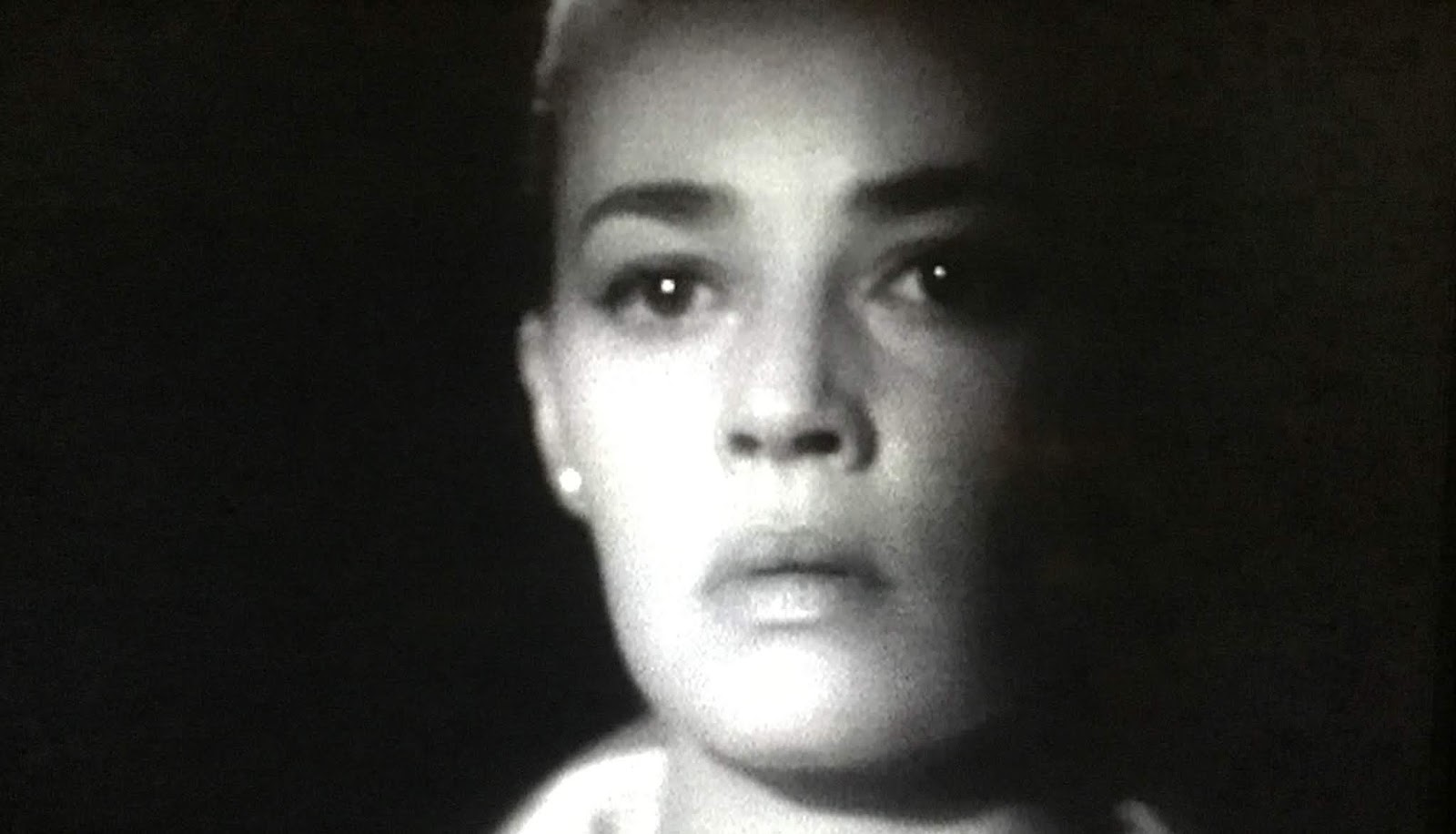
Malle, then a documentary filmmaker, and his friend the novelist Roger Nimier stylized a potboiler roman policier into a true crime narrative of a Perfect Crime gone awry. Unlike the potboiler, Malle and Nimier’s story revolves around the lightly made-up face of Jeanne Moreau filmed by master cinematographer Henri Decaë using Tri-X film in natural light, mostly at night. Decaë had shot Bob le Flambeur for Jean-Pierre Melville in 1956. François Truffaut used him for Les quatre-cent coups in 1959.


Elevator to the Gallows revolves around Jeanne Moreau’s lightly made-up face.
Moreau was at the time an accomplished stage actress of the Comédie-Française unremarkable in about two dozen films. Her character and perhaps her film stardom was born the moment she raised an eyebrow in a close-up while talking with her lover on the telephone during the film’s title sequence. 

Florence’s raised eyebrow launches Jeanne Moreau’s movie stardom.
The diverse cast and extras appear in the film less as ‘characters’ than as people one might see in a documentary or in still photography of the period. Each of them draws the viewer’s attention because we sense that we are watching their lives. As Barbet Schroeder later said of his and Eric Rohmer’s directing work: ‘You are hanging out with people and it’s their life you are watching. The movie-making is only an abstraction. It’s their life you are watching and you want to make your audience a participant.’


A barstool storyteller intrigues Florence (Jeanne Moreau) in Elevator to the Gallows.
And then jazz trumpeter Miles Davis and Paris-based musicians whom the film producers brought together for the project responded musically to the finished film. Davis’s improvised score, a blue mood that finds melodies in E minor without harmonic movement, was a first for the movies. It helped Davis find his way to the new sound he achieved in Kind of Blue about a year later (1959).  


Jeanne Moreau watches Miles Davis, bassist Pierre Michelot, and tenor sax Barney Wilen develop Davis’s score for Elevator to the Gallows.
In the end, Malle’s stars and those of the crew he brought together lined up so well that they pulled off a marvelous caper: the director’s first feature film, Ascenseur pour l’échafaud—Elevator to the Gallows.
 

Part of the trick was making a drama look like a documentary. There are technical, forensic, and legal details over which one can quibble; but Moreau, the film’s mood, the lovely shots and montage, the cast, and Davis’s score make the audience a participant and are a testament to the caper’s success. Malle and his crew made a great picture.


Julien (Maurice Ronet) does not reflect in the elevator in Elevator to the Gallows.
The story is simple. Julien Tavernier (Maurice Ronet), a former Foreign Legion officer and veteran of the wars in Vietnam and Algeria, is the right hand of arms dealer Simon Carala (Jean Wall). But Julien and Carala’s young wife Florence (Moreau) plot to stage Carala’s suicide and live happily ever after. Julien sets about this task with military efficiency on a Saturday morning.


Louis (Georges Poujouly) admires his blouson noir in a window in Elevator to the Gallows.
Louis (Georges Poujouly), a blouson-noir or James Dean-style Parisian ‘juvenile delinquent’ in a black leather jacket, admires himself in the window of the flower shop where his girlfriend Véronique (Yori Bertin) works. The shop is across the street from Carala’s office. Véro is helping to close the shop on Saturday afternoon. Louis notices that someone left a fancy 1952 Chevrolet Styleline convertible idling on the curb outside the shop.


Véronique (Yori Bertin) joyrides with Louis (Georges Poujouly) in Elevator to the Gallows.
Julien is on the elevator to the gallows. Florence sees his convertible fly by where she is waiting for him, but with the silly flower shop girl in the passenger seat. She assumes that Julien is the driver. Having no idea what happened at the office—and of course no cell phone—she sets off on a disconsolate all-night walk about Paris filmed in sequences of long tracking shots.


Florence (Jeanne Moreau) loses herself in Paris’s night streets in Elevator to the Gallows.
Jeanne Moreau in the ambient light of Paris at night in Elevator to the Gallows.
Inspector Chérier (Lino Ventura) is called to investigate a murder at a modish motel where well-heeled clientele arrange assignations and no one is in a hurry to cooperate. And Julien finds himself back on the street.


Some shots and sequences in Elevator to the Gallows tip a hat to Alfred Hitchcock.

Other shots mimic the classic Paris photography of Brassaï, Cartier-Bresson, Doisneau.
These vignettes intimate the chain of personal catastrophes set in motion. It will take the inspector and his assistant (Charles Denner) until the film’s end to wrap up the loose ends in a photography darkroom.

Inspector Chérier (Lino Ventura) plays good-cop with Florence (Jeanne Moreau).
Ascenseur pour l’échafaud (Elevator to the Gallows) 1958 France (91 minutes) Gaumont/Criterion. Directed by Louis Malle; screenplay by Roger Nimier and Malle, based on a novel by Noël Calef; cinematography by Henri Decaë; edited by Léonide Azar; music by Miles Davis.
 

Friday, June 7, 2019

Hitchcock for children

In Ted Tetzlaff’s The Window, based on a story by pulp writer Cornell Woolrich, one of Woolrich’s wonted ‘scared little guy’ protagonists is exactly that: a nine-year-old boy who witnesses a murder.

The film’s deft shooting, tight editing, and quick pace—it runs for little more than an hour—keep its child protagonist scarcely a step ahead of danger. 

Joe Kellerson (Paul Stewart) pursues the lone murder witness in The Window (1949). 
The story is a loose adaptation of Aesop’s The Boy Who Cried Wolf: a boy with an active imagination witnesses a murder. In this instance, and with the murderers hovering in pursuit, the boy nearly dies trying to convince adults—his parents, at their wits’ end over his tall tales about ‘indians and gangsters’, no less than the police—of what he saw.
Skeptical parents Mary (Barbara Hale) and Ed (Arthur Kennedy) Woodry in The Window (1949).

Tetzlaff shot the picture in a documentary style on location, in the then tenement-filled Lower East Side of Manhattan where Jacob Riis’s Other Half lived a half-century before, mostly from the boy’s point of view. It is similar in style to the 1953 classic The Little Fugitive by Morris Engel, Ray Ashley, and Ruth Orkin.
Tommy Woodry (Bobby Driscoll) imagines adventure in The Window (1949).
Tommy Woodry (Bobby Driscoll, whose work in this picture contributed to his honorary Academy Award in 1950) is a lonely only child with a lively fantasy life. In response to neighborhood boys’ teasing Tommy when he tells them he is getting a horse, Tommy assures them that his family is moving soon to a ranch in Texas, ‘to Tombstone, or wherever Tombstone is.’ Later the same day, having heard that the family is moving, the Woodrys’ building super knocks on the door of their apartment hoping to show the place to prospective tenants—the New York real estate scene is remarkably little changed. 
Tommy Woodry (Bobby Driscoll) sleeping on the fire escape in The Window (1949)
And on a hot summer night Tommy gets his mother Mary (Barbara Hale) to let him sleep outside his bedroom window on the fire escape. Tommy sees a breeze blow laundry on the line above; he takes his pillow a floor higher and lies outside a window of the apartment upstairs. He hears a commotion inside. He watches wide-eyed through a partly-opened blind as the upstairs neighbors Joe Kellerson (perennial film noir bad guy Paul Stewart) and his wife Jean (Ruth Roman) roll and then murder a drunken sailor (Richard Benedict). Tommy slips away before the Kellersons see him. His challenge is making someone believe him.
Detective Ross (Anthony Ross) dubious of Tommy’s tale (Bobby Driscoll) in The Window (1949)
But everybody knows that the Kellersons are just an ordinary couple. Tommy’s parents Mary and Ed (Arthur Kennedy) fear that his story-telling may signal deeper psychological problems. A Hitchcockian dramatic touch comes when Mary marches the horrified Tommy upstairs to apologize to the Kellersons for telling his parents and the police stories about them—and of course tips off the Kellersons that someone may have seen what they were up to.
‘Normal neighbors’: Barbara Hale, Ruth Roman and Bobby Driscoll in The Window (1949)
When Tommy refuses to speak, his mother apologizes for him: ‘Please don’t pay any attention to him. He’s always making up stories. If it isn’t indians, it’s gangsters; and if it isn’t gangsters it’s something else. Someone’s always getting killed.’
Wide-eyed witness to a murder in Ted Tetzlaff’s The Window (1949).
The through-the-blind, voyeuristic element of the story makes it similar in effect to Alfred Hitchcock’s Rear Window which also is based on a Cornell Woolrich story. Both Hitchcock and Woolrich told stories in which evil lurks just beneath the surface of the conventionally normal. This one is sweet, short, and satisfying.
WeeGee’s classic pic shows fire escapes were much more crowded.  
The Window 1949 U.S. (73 minutes) RKO Radio Pictures. Directed by Ted Tetzlaff; screenplay by Mel Dinelli based on the story The Boy Cried Murder by Cornell Woolrich; cinematography by Robert De Grasse and William Steiner; edited by Frederic Knudtson; produced by Frederic Ullman Jr. and Dory Schary.
Life in a Lower East Side street in Ted Tetzlaff’s The Window (1949)
 

Tuesday, May 28, 2019

Shadows! Action! Camera!

This B-picture gem directed by Robert Parrish provides a fun and satisfying excursion through Hollywood’s idea of the post-World War II Angeleno underworld.

Detective Lt. Gus Cobb (Regis Toomey) and Rocky Mulloy (Dick Powell) in Cry Danger.
The film is a masterpiece of the form. The plot is tight. A salad garden of character actors make for a colorful ensemble. The dialog is snappy. The montage is intricate and beautifully laid; deft editing punctuates the narrative. The music cries ‘Danger!’ And Parrish delivers the whole package in under 80 minutes. MP’s rundown includes no spoilers.

A dreamy-eyed cigar stand clerk (Gloria Saunders) dissolves in Cry Danger.
After a Marine war hero’s testimony leads to the release of a man doing a life sentence, the ex-con returns to Los Angeles to get to the bottom of the wartime Aetna payroll robbery and killing for which he was convicted. The civilian, Rocky Mulloy (Dick Powell), and his best friend, an ex-Marine named Danny Morgan were convicted for the heist five years before. Morgan got a 5-to-10-year sentence as Mulloy’s accomplice. The $100,000 take never was recovered. 
The action as though revolves around Los Angeles City Hall, first shown from Union Station and seen in the last shot from a trailer park on Bunker Hill.
Fresh out of prison, Mulloy first heads to see Danny’s wife Nancy (Rhonda Fleming) who once had been Mulloy’s girlfriend. Detective Lieutenant Gus Cobb (Regis Toomey) picks up Mulloy right after he gets into Union Station and makes clear to him that he expects to Mulloy to lead him to the missing money. Walter De Long (Richard Erdman), the decorated Marine veteran whose testimony cleared Mulloy, also turns up. De Long is less motivated by justice than a sporting man’s interest in the whereabouts of the robbery take. 
In the time-tested movie detective story tradition, no one following the newspaper reporting of the robbery actually believes in the rule of law: the governor’s pardon means only that Mulloy beat the system and got over on the squares. These wised-up gentry do not believe in Santa Claus: Mulloy has a line on the missing money and will recover it. On the other hand, it is unclear how Mulloy makes a living. His murky connection with the robbery thickens the plot, and he is acquainted with at least one Los Angeles organized crime figure, the cherubic, smiling Louis Castro (William Conrad).

Rocky Mulloy (Dick Powell) and Louis Castro (William Conrad) in Cry Danger.
Mulloy’s job is to walk the cat backwards to the money. He partners with De Long, a disabled veteran with one leg and a drinking problem, to get himself back on his feet. They share a rattletrap trailer in the trailer park where Nancy Morgan lives, and De Long’s car, a uni-body, two-door 1950 Nash Statesman 600, a dream car for any latter-day Angeleno lowrider.

Lowrider dream car: a uni-body, two-door 1950 Nash Statesman 600 in Cry Danger.
Their trailer park neighbor Darlene ‘Fingers’ LaVonne (Jean Porter), who introduces herself as ‘a sort-of part-time model’ is another benefit. This is a day when men were men, girls were girls, and boy did they have a high old time playing each other. Light-fingered, I-call-everybody-honey Darlene is the first of a number of character actors that make this story fun to watch.
Darlene ‘Fingers’ LaVonne (Jean Porter), ‘a sort-of part-time model’ in Cry Danger.
There is also Williams (Jay Adler), the trailer park manager and bard who plucks the blues on a ukulele; Alice Fletcher (Joan Banks), the lustful young widow of a bribed witness; Russell (Benny Burt), the bartender at Castro’s Los Amigos bar; a dreamy-eyed cigar stand clerk (Gloria Saunders); and Harry, a self-deprecating bookie in a zoot suit (Hy Averbach), among others.

Harry, a self-deprecating bookie in a zoot suit (Hy Averbach) in Cry Danger.
This movie is not a Great Classic like The Maltese Falcon or The Big Sleep in the sense that Elmore Leonard’s novels are not Great Literature. But like Leonard’s work it delivers more than the total of its fine parts, it is fun, flawlessly executed, and there are no boring parts.


As De Long says to Darlene: ‘Let’s get out of this sun and into a nice cool bar.’


De Long and Darlene: ‘Let’s get out of this sun and into a nice cool bar.’
Shadows! Action! Camera!

Cry Danger 1951 U.S. (79 minutes) RKO Radio Pictures. Directed (and edited) by Robert Parrish; screenplay by William Bowers based on a story by Jerome Cady; director of photography Joseph F. Biroc; music composed and conducted by Hugo Friedhofer.
 

Monday, May 6, 2019

The Incurable Weirdness of Racism

The unsettling thing about Sam Fuller’s White Dog (1982) is not that it depicts racism, but that it dispassionately examines its incurable weirdness like a patient etherized upon a table.

The patient’s malady is embodied in a large white German shepherd. The dog is introduced at the beginning when a young woman hits him with her car while driving at night. She takes the dog to a veterinarian for emergency treatment.
Julie Sawyer (Kristy McNichol) and her ‘four-legged time bomb’ in White Dog (1982).

The dog’s injuries are superficial. The woman, an aspiring actress named Julie Sawyer (Kristy McNichol), afterward takes the dog to her home in the Hollywood Hills. Julie and her boyfriend, Roland Grale (Jameson Parker), a young screenwriter, post local notices that she found the dog. The dog tends to be jealous for Julie’s attention; Roland becomes more favorably inclined toward this large rival with a healthy set of canine teeth after he deters a would-be rapist (Karl Lewis Miller) in Julie’s home and then holds the intruder outside until the police arrive.

A rampant German shepherd displays a healthy set of canine teeth in White Dog (1982).
So far, so good. But then a scene on Rodeo Drive shows viewers what Julie subsequently discovers after the dog viciously attacks Molly (Lynne Moody), an African-American actress, during a movie shoot. The dog strikes suddenly while Julie and Molly are saying their lines on a rocking Venetian gondola surrounded by a film crew in a movie studio. Roland warns Julie that the dog is ‘a four-legged time bomb’, but she believes that he can be trained. She takes him to Noah’s Ark, a business run by Carruthers and Keys, professional movie animal trainers, as a last resort to find someone who can help him.
Burl Ives as Carruthers and Paul Winfield as Keys in White Dog (1982).
Carruthers (Burl Ives) is a campy old showman who throws tranquilizer darts at a full-sized cardboard image of a ‘tin and flashing lights’ Star Wars robot. His claim to fame is that his hand doubled for John Wayne’s to defy rattlesnakes in True Grit. Lion-wrestling Keys (Paul Winfield) is a trained anthropologist who did not follow in the academic footsteps of his parents. ‘To me, this [training business] is the laboratory that Darwin himself would go ape over!’ Keys later tells Julie.

When Julie first meets Carruthers in his office and tells him her ‘problem’, he gravely explains that no one can train ‘an attack dog gone bad’. The muzzled dog stays calmly at heel in the office until he bolts into the yard outside to subdue one of Carruthers’s black employees.
Joe (Bob Minor) gets the business end of a dog in Sam Fuller’s White Dog (1982).
‘That ain’t no attack dog you got, that’s a White Dog!’ Carruthers said, pulling the dog off the man.

‘Of course he’s a white dog!’ Julie said.

A white dog indeed! Carruthers explains to Julie that a White Dog is a dog trained to hunt and attack black people. The ‘etherized patient’ to which we alluded at outset is that what appears inconceivable to a young white Angeleno like Julie is simply another fact of life to black men and a white animal trainer who knows dogs.

Joe (Bob Minor), the black man the dog attacked, pulls up his trouser leg to show the disbelieving Julie a large scar on his calf. ‘You see that scar, lady? I got that when I was just 14. A White Dog did it.’

Joe (Bob Minor) shows a disbelieving white dog owner what a White Dog can do.
Keys, who also is African-American, happens along after Carruthers restrains the dog. He confirms what the others tell Julie but dares disturb the universe by accepting the challenge of training the dog. McNichol stars in her first adult leading role, but Winfield carries the picture because the heart of the story follows his character’s effort and work to recondition the dog.
Paul Winfield’s animal trainer Keys carries the story in Sam Fuller’s White Dog (1982).
The dialog can be ham-handed, but the story is earnest without being didactic or sentimental. It is more like a newspaper story than a movie: Fuller did newspaper reporting from the South in the 1930s. On the other hand, although the film’s narrative focus is the White Dog, it is hard to believe that law enforcement and the news media would not have shown a more active concern about an animal serially mauling and killing citizens black or white.  
A black hand (Sam Laws) tests a White Dog’s training progress in White Dog (1982).
White Dog 1982 U.S. (90 minutes) Paramount/Criterion. Directed by Sam Fuller; screenplay by Fuller and Curtis Hanson, based on a story by and dedicated to Romain Gary; director of photography Bruce Surtees; production designer Brian Eatwell; edited by Bernard Gribble; music by Ennio Morricone; produced by Jon Davison.

Sunday, April 28, 2019

Showtime’s Billions as space opera

Try imagining Showtime’s Wall Street cops ‘n’ robbers series Billions as a sci-fi adventure we’ll call Star Trek Voyeurs: The Far Frontiers of Finance.
Bobby Axelrod (Damian Lewis) captains ‘robber’ Starship Axe Capital in Billions.
Hedge fund maven Bobby Axelrod (Damian Lewis) captains Starship Axe Capital, his clinically pristine, all-glass mothership crewed by mutant humanoids and androids of the species Homo pecuniarius with an BDSM dominatrix (Maggie Siff) as morale officer. Axe’s merry band of cosmic traders and others in a starfleet federation of hedge funds probe financial deep space and legal black holes for personal wealth beyond anyone’s wildest dreams—billions!
Chuck Rhoades (Paul Giamatti) leading the ‘cops’ SDNY in Billions.
Yet in a not-so-far-off corner of the same universe lurks the righteous and warlike species Homo foederatus. Led by the dyspeptic Chuck Rhoades (Paul Giamatti) with a velvet fist in a Teflon glove, this litigious species is comprised of ever-scheming career mutants and just-plain-joes in rack suits who populate the Police Plaza asteroid, part of a Federal Galaxy ruled by a Darth Vader figure called ‘General’.
Clancy Brown as ‘The General’ in Billions.
The facts, unfortunately, are more prosaic.

Wall Street and the Office of the US Attorney for the Southern District of New York (SDNY) is the American League East of US finance and law professionals. Billions’s principals and several of its less-hinged characters may be how some financiers and government lawyers fancy themselves. But having covered this world and its activities as a reporter, we found Billions characters, plots and story lines to get more far-fetched with each of the first three seasons.

Billions showrunners may have pitched the series as The Sopranos meets Wall Street. But ninety-nine-and-nine-tenths percent of what the characters in Billions do is office work. Even though a lot of designer luggage filled with bundles of $100 bills gets moved around, the nerdy, one-dimensional nature of people self-involved in the mathematics of high finance on the one hand and lawyers’ office politics on the other is a lot less colorful as drama than psychotic middle-aged, blue collar Italian-American males with cute nicknames who meet in a deluxe titty bar to josh each other and divvy kickback money and plot who to extort and whack next.
John Malkovich as Russian kleptarch Grigor Andolov in Billions.
This is no reflection on the actors’ fine work in Billions’s cast of stinkers & nasties, not least of whose task is retailing enough pop culture, movie and television references to make even Quentin Tarantino’s head spin. John Malkovich does his Malkovich thing as a Russian kleptarch: the showrunners missed primo pop-ref opportunities by not naming his character Boris Badenov and casting Cameron Diaz as Natasha Fatale. The best of the worst may be Charles ‘Dad’ Rhoades (Jeffrey DeMunn), father of Chuck (Giamatti), the US Attorney for the SDNY. Dad is a fiendishly foolish and entirely unsympathetic entitled old bantam rooster, and DeMunn swings this role with real aplomb.
Paul Giamatti and Jeffrey DeMunn as Chuck and Charles Rhoades in Billions.
The challenge at the heart of this show may be making viewers care about characters whose lives center on their work. The Sopranos is about family. Its devoted following and longevity comes from its characters’ relationships with each other. It may be a pleasure and privilege for the men to be mobsters, but that’s just work: the show draws us in because it tells stories about these people’s relationships, centering on the marital relationship between Tony and Carmela Soprano.
Maggie Siff’s Wendy Rhoades makes for the narrative fulcrum in Billions.
Both the cops and robbers in Billions feature a potpourri of personalities, similar to the various Star Trek franchises’ dysfunctional families, which reflect the typical contemporary American workplace. There are ‘families’, but no one really has a life outside of work. Rhoades’s wife Wendy (Siff) is the narrative fulcrum because she in effect ‘marries’ the work environments of her husband’s cops and her employer’s robbers.
Asia Kate Dillon as wunderkind Taylor Mason in Billions.
Thus it is fitting that the most compelling character to emerge is the one most dedicated and best at their work. Taylor Mason (Asia Kate Dillon) presents as nonbinary, goes by third person plural pronouns, and lives the math in a world in which nearly everyone else ‘does’ it. Taylor appears to employ coming off as a sci-fi android as their magician’s white glove. They are smart, but young; and they have an ethical and emotional core that may end up being their Achilles heel—a mythical story to which Taylor refers in season three: ‘His mother had to hold him somewhere to dip him,’ they said.
Aboard the Starship Axe Capital in Showtime’s Billions.