Sunday, March 6, 2022

What a Frightfulness

The Night of the Hunter (1955) is a classic American Gothic nursery tale.

First heard in a dark cinema, the opening bar of Joel and Ethan Coens’ True Grit (2010) made the hair tingle on the back of my neck. 

There is nothing sinister about the tune. The Coens are connoisseurs of the American Songbook and their theme, the Victorian gospel workhorse “What a Fellowship,” also known as “Leaning on the Everlasting Arms,” is a model of earnest American revivalist inspiration.

“Preacher” Harry Powell (Robert Mitchum) and Willa Harper (Shelley Winters) “Come rejoicing, bringing in the sheaves” at a church social on the river.

But they also season their work with allusions to film classics. My shock in recognizing the hymn was the clear allusion to the 1955 classic The Night of the Hunter. In that film, the hymn’s refrain “Leaning, leaning, leaning on the everlasting arms” is baritoned as a leitmotiv by a charming, darkly menacing sociopath in black. It is a simple tune, easy to remember. This context is hard to forget.

Relentless demon Harry Powell (Robert Mitchum) casts a menacing shadow in The Night of the Hunter (1955).

Shot in Moundsville, West Virginia, Charles Laughton’s The Night of the Hunter was based on a literary true-crime story about a serial murderer of women published two years earlier by Davis Grubb, set in the Depression-era Appalachians. Out-of-luck Ben Harper (Peter Graves) has killed two people while robbing a small-town bank of $10,000 (roughly $100,000 today) so as not to see his two small children, John (Billy Chapin, age 10) and Pearl (Sally Jane Bruce, age 5) join the bands of homeless, hungry waifs hard times had made.

Depression-era waifs on the road in The Night of the Hunter (1955).

Written by James Agee, known for his “Let Us Now Praise Famous Men” (1941) which documented the lives of Depression-era Alabama sharecroppers, the film opens with a short Sunday school lesson to children by the character we meet later as Miss Rachel Cooper (Lillian Gish). Miss Cooper quotes Scripture in a voiceover as Laughton and cinematographer Stanley Cortez’s images introduce the story on-screen.

Miss Rachel Cooper (Lillian Gish): “I’m a strong tree with branches for many birds. I’m good at something in this world and I know it.” The Night of the Hunter (1955).

“Beware of false prophets, which come to you in sheep’s clothing, but inwardly they are ravening wolves. Ye shall know them by their fruits… A good tree cannot bring forth evil fruit, neither can a corrupt tree bring forth good fruit… Wherefore by their fruits ye shall know them.” (Matthew 7:15-20)

“Ravening wolf” Harry Powell (Robert Mitchum): “You say the word, Lord, I'm on my way.”

Harry Powell (Robert Mitchum) is a corrupt tree, a sociopathic religious intolerant who comes not in peace but with a switchblade. He uses the language of the King James Bible to woo and impress church-going, small-town folk. But arrested for stealing a car, “Preacher” Powell does not impress the judge who gives him 30 days in the lock-up. Next we see Ben Harper’s arrest through his children’s eyes: Daddy gets home enough ahead of pursuing state troopers to hide the money with John and Pearl before four troopers arrive and subdue him. Ben is sentenced to hang for the two murders incident to the robbery.

Ben Harper (Peter Graves) stays mum with prison bunkmate Harry Powell (Robert Mitchum) in The Night of the Hunter (1955).

Although unlikely that a misdemeanor car thief would share a cell in a state penitentiary with a death row inmate, this is how Powell crosses paths with Harper. Powell twigs that Harper hid stolen money but cannot get him to say where it is before he is executed. When Powell gets out, he loses no time making a move on Harper’s family. He pretends to be the prison preacher in whom Harper confided. He “converts” and marries Ben’s widow Willa (Shelley Winters) as he skulks menacingly nice after John and Pearl.

“Preacher” Harry Powell (Robert Mitchum) “converts” and marries Willa Harper (Shelley Winters) in The Night of the Hunter (1955).

Winters deftly underplays the role of a tragic “straight man”. (She would fare little better parenting with “Hum, baby” in Lolita seven years later.) She is the mother of the children who are the antagonist’s quarry and, as a widow and victim, she is the focus of the town’s righteous chorus led by the shrewish Icey Spoon (Evelyn Varden). Besides the children, the only detail we know about Willa’s marriage with Ben Harper is that a Confederate general (Nathaniel Bedford Forrest?) watches over the bed they shared. She looks forward meekly with faith to a fulfilling union with the dark, handsome Man of God.

This eerie dissolve is among many exquisite shots and edits in The Night of the Hunter (1955).

To avoid spoilers, circumstances force the children to take flight on the river pursued by their relentlessly menacing demon. The river delivers them to Miss Cooper mentioned above, perhaps irresistibly, as they appear as though in an American folk rendition of “an ark among the flags at the water’s brink.” They take refuge with this godly, tough-love, self-sufficient senior to set up the dramatic showdown.

Ruby (Gloria Castillo) and Miss Cooper (Lillian Gish) scrub their “two more mouths to feed”, Pearl (Sally Jane Bruce) and John (Billy Chapin) in The Night of the Hunter (1955).

Laughton shot the film in black-and-white in that German-Expressionist-inspired style known as film noir. A number of shots and editing transitions are exquisite. But Laughton adds a dimension to “noir” by posing a Manichean duality: Powell’s malevolent darkness contrasts with Cooper’s wakeful, stern-but-loving lightness. This Manicheaism dramatically stands out when Cooper, guarding her lambs with a shotgun at the film’s denouement, sings “Lean on Jesus” in gospel antiphon to Powell’s “Leaning” refrain and first stanza, “What a fellowship...”

Miss Cooper (Lillian Gish) sings in gospel antiphon to Harry Powell’s (Robert Mitchum) relentless gospel leitmotiv in The Night of the Hunter (1955).

This is
unfortunately the only film directed by Laughton, a fine stage and film actor and theatrical director, and one of the few screenplays by the writer and film critic James Agee. Each, though noted in his day, has been better appreciated posthumously. Nor did their film do well at the box office, though it too has become a classic. 

“I come not in peace but with a sword.” Pearl (Sally Jane Bruce), John (Billy Chapin) get a life lesson from “new daddy” Harry Powell (Robert Mitchum) in The Night of the Hunter (1955).

Mitchum, playfully diffident offscreen, has few peers when it comes to onscreen menace. A large, solidly-built man with dark features and hooded eyes, he radiates a “don’t give a damn” charisma which with his dominating physicality combines menace, sexuality, and playfulness in ways that made him an icon of 1940s and 1950s film crime dramas. Mitchum’s Max Cady in the original Cape Fear (1962) is a more intense, sexually-aberrant version of Powell in this film. 

John (Billy Chapin) and Pearl (Sally Jane Bruce) keep steps ahead of their “new daddy” (Robert Mitchum).

Gish holds her own here. She established herself early in the silent era and starred in such classics as D. W. Griffiths’s Broken Blossoms (1919) and Victor Sjöström’s The Wind (1928). She reportedly learned to shoot from Al Jennings, a real-life train robber who later played one in movies (and longtime friend of O. Henry whom he met in prison). Gish made her characters strong from her earliest films to her last, The Whales of August (1987), in which she costarred with Bette Davis—and in which “bumpy night” seat belts undoubtedly were standard equipment. She died aged 99 in 1993. 

Miss Cooper (Lillian Gish, who learned to shoot from old-time train robber Al Jennings): “He ain’t your daddy, and he ain’t no preacher either.” The Night of the Hunter (1955)

The Night of the Hunter
1955 U.S. United Artists/MGM (92 minutes). Directed by Charles Laughton; screenplay by James Agee and Laughton from the novel by Davis Grubb; cinematography by Stanley Cortez; editing by Robert Golden; music by Walter Schuman; produced by Paul Gregory.

Friday, December 3, 2021

Le Midi, je t'aime

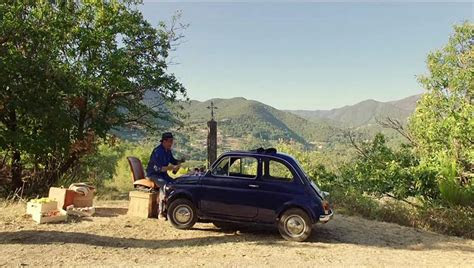
The Man in the Hat (2020) relates its hero’s travels through the Midi’s picturesque summer landscapes to light touchstones to memory. With poignant and comic vignettes in mime and an amazing soundtrack, all is order and beauty, luxury, peace, and pleasure.
The
story at first feels as though a recurring dream in which The Man (Ciarán Hinds) drives a Fiat 500 on the narrow roads of rural southeastern France; on the seat next to him is the framed black-and-white photo of a young woman. The audience experiences the foreign life around The Man with his visitor’s reserve. His encounters are mostly in mime, like French classic Jacques Tati’s Monsieur Hulot. As The Man makes his way, he draws out people’s best qualities and brings strangers together. Released in the UK in September 2020 and in the US last May, this unusual and entertaining sleeper deserves to be seen.

Camargue dogs (Richard Henry, Conor Levitt, James Lailey, Sylvain Thirolle, and Mike Pickering) in The Man in the Hat (2020)

The story gets off to a quick start when The Man flees Marseilles pursued by five bald reservoir dogs in an orange and blue Citroën Dyane. The men dumped a body-sized object in the harbor and then realized that The Man, dining at an outside café, had seen them. The Man and the audience recall an earlier tabloid headline “Meurtre parmi les Mafieux à Marseilles” (Murder Among the Marseilles Mafiosi). A woman in a roadside café (Claire Tran) later fans his fears when he overhears her stage-whisper to a friend (Laurie Ravaux) an oh-my-god! story that involves her husband and the Mafia and ends “Pouf! Disparu!” The Man continues his sentimental journey mindful only to keep out of the gang’s sight.

A café patron (Claire Tran) tells a friend (Laurie Ravaux) an oh-my-god! story that ends “Pouf! Disparu!” in The Man in the Hat (2020)

The Man at first experiences the narrative in images and music much as the audience does; the few spoken words throughout the film are incidental and in French (with subtitles). The Man may be a foreigner, though not necessarily so. The story pivots rather than plots; its episodes feature a cast whose performances are as rich and surprising as the film’s music.
An attractive middle-aged local, The Woman (Sasha Hails), rides a bicycle in and out of episodes. An eccentric who resembles Fedor Dostoevsky and whom the credits identify as The Damp Man (Stephen Dillane), appears at first depressed and alone and later much improved with a vivacious partner, The Chef (Muna Otaru), and a champion chicken. A pair of gay farmers (Sam Cox and Didier Bourguignon) are masters of pantomime, and a pair of “Measurers” (Amit Shah and Zoé Bruneau) uniformed as local government or utility employees keep turning up compulsively measuring roads and public spaces but more specifically each other. A uniformed Official (Xavier Laurent) appears when needed to validate “documents”.
Other characters appear in vignettes: The Hotel Manager (Brigitte Roüan), The Biker (Maïwenn), The Older Man (Joseph Marcell) and The Older Woman (Sheila Reid), a priest (Jeremy Herrin), moving nuns, a group of cyclists, actors staging “A Midsummer Night’s Dream,” and not least the five men in the Dyane (a car last produced in France in 1983).
But good music is the lifeblood of this film. Musicians turn up along the route, from a zydeco duo on small local ferry, to the tenor Mark Padmore breaking into song (“Venezia”) at an auberge dinner table accompanied by a classical guitarist (Dario Rossetti Bonell), to the singer Matilda Homer and two others in The Man’s Fiat singing “Memory” which Homer wrote for the movie, to women garage mechanics singing of lost cars and lost cigarettes, to The Nadine Lee Band performing Otis Redding’s “Try a Little Tenderness” in a village square, to a klezmer band at a village festival.
Two lovely
aural details are a recurring theme reminiscent of those Nino Rota wrote for Federico Fellini (though Alain Romans’s “Quel temps fait-il à Paris?” used by Tati may come nearer the mark), and a warm jazz saxophone like Cannonball Adderley’s on several numbers, including “The Pizza Van” in a scene in which The Man orders a pizza from a food van and The Damp Man and The Chef dance while making it.

The Official “validates” The Man’s journey which the latter summarized on the back of the woman’s photo with the opening lines of Charles Baudelaire’s “L’Invitation au Voyage” (the poem’s refrain is quoted in our opening):

“Mon enfant, ma sœur,
Songe à la douceur
D’aller là-bas vivre ensemble!”

(My child, my sister,
Muse on the sweetness
Of living together there!)

The Man in the Hat 2020 U.K. (95 minutes) Open Palm Films/Rather Good Films/Gravitas Ventures. Directed and written by John-Paul Davidson and Stephen Warbeck; music by Warbeck; casting by Nanw Rowlands; cinematography by Kanamé Onoyama; editing by Peter Boyle; produced by Daniel-Konrad Cooper and Dominic Dromgoole.

Saturday, November 27, 2021

McCabe & Mrs. Miller

Fifty years ago director Robert Altman put a glam 1970s couple in an unglam picture titled McCabe & Mrs. Miller (1971). The film is worth seeing today because Altman’s magic and the ability and star power of Warren Beatty’s John McCabe and Julie Christie’s Mrs. [Constance] Miller shine through just as freshly as they did fifty years ago.
For an audience that knows Clint Eastwood’s Unforgiven (1992), the Coens’ True Grit (2010) and The Ballad of Buster Scruggs (2018), and Quentin Tarantino’s neo-spaghetti Westerns, it might be difficult to see this film as a break from the genre as it was seen in its day. Fairer perhaps to classify movies like this in their own sub-genre of “auteur Westerns”; the trails of this and other genres were blazed by auteurs finding their own way. If anything, Altman’s focus here on his two stars is a break from his characteristic narrative flow of multiple simultaneous story lines.
Part of the unglam
and wonder of McCabe & Mrs. Miller is that the filmstock was “fogged”, a technique which makes the images grainy. Another part is that Altman shot the film in a frontier town built for the project from trees felled and milled on the site of a formerly unspoiled location in British Columbia. During the fall and winter of shooting, the crew expanded the set from a tent camp to a small town. The structures are not theatrical flats: Altman’s crew lived on the site and people building the sets appear in the background of the action: casual clothing and tonsorial styles from the mid-1960s to the mid-1970s sometimes followed received notions of how frontiersmen dressed. The fall rain and mud and winter snow and cold also are real.
The film opens with
McCabe riding into Bearpaw to Leonard Cohen’s “The Stranger Song”. This gives the picture a 1970s period feel. The viewer sees little more than a tent mining camp with a dominant church. The well-dressed stranger has big plans to open a saloon with a gaming parlor and a whorehouse. The innkeeper Sheehan (Rene Auberjonois) and the other locals guess that McCabe is a professional gambler from the glib way he deals cards. Word soon goes round that he is a dangerous gunman: Bearpaw has no sheriff and no one else in town wears a sidearm or carries a gun. McCabe brings in three whores he bought from a pimp in another town to get his business going. The women are far from pinup models. But the locals long without women are no less impressed by “the girls” than they are by the rest of McCabe’s effects.
B
efore long, an experienced madam brings her own stable to town. Mrs. Miller, from London purportedly by way of San Francisco, sees right off that McCabe wows the locals because he can patter circles around frontier miners. But he lags a fur piece behind sophisticated city folk. In her secretly opium-assisted semi-retirement, Mrs. Miller also knows a male ally gives her the best shot at growing a nest egg. McCabe and Mrs’ Miller’s combined services delight the locals and their relationship develops with their little “empire”.
But no Eden lasts forever.
An American corporate interest smells money in them thar hills and offers to buy out McCabe. McCabe reckons he can hem and haw, scratch his head, stroke his chin, and shake down the city slickers. Mrs. Miller knows he can’t; she warns him. Men with guns turn up. McCabe’s high noon tolls in a blizzard while the townspeople bond putting out an accidental fire that threatened their unused church.
McCabe & Mrs. Miller
1971 U.S. (120 minutes) David Foster Productions/Warner Bros. Directed by Robert Altman; screenplay by Altman and Brian McKay from the novel “McCabe” by Edmund Naughton; cinematography by Vilmos Zsigmond; editing by Lou Lombardo; music by Leonard Cohen; produced by Mitchell Brower and David Foster.