Thursday, April 9, 2020

Two for the Seesaw


Two for the Seesaw’s seemingly odd pairing of actors makes it an authentic romantic drama of the false starts and uncomfortable snags that the twice-shy find in opening up to another a second time around.
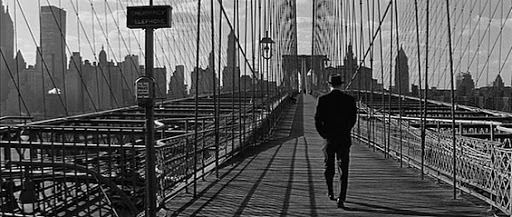
Robert Mitchum crosses Brooklyn Bridge in Robert Wise’s Two for the Seesaw (1962).

Robert Wise's black-and-white film opens with a lovely title sequence of panoramic shots of lower Manhattan, to a bluesy André Previn score. Film noir veteran Robert Mitchum crosses Brooklyn Bridge alone on foot. He ambles through lower Manhattan on what feels like an overcast Sunday morning to a walk-up tenement apartment on Mulberry Street near Prince. It looks like a dead ringer set-up for film noir; but Mitchum’s body language lacks purpose and menace. 

Mitchum’s Jerry Ryan is a successful middle-aged Nebraska lawyer who finally got enough of going through the motions of a gilt-cage life when his wife of twelve years filed for a divorce. He left Lincoln with $500 in his pocket and an idea to reinvent himself in New York. At a party in Greenwich Village he is drawn to Shirley MacLaine’s lively Gittel Mosca (shortened from Moskowitz) “from Brooklyn by way of the Bronx,” as she says. Gittel is a dancer and costume designer almost 30, briefly married, on her own in bohemian Manhattan since she was 16.
Shirley MacLaine’s Gittel Mosca reflects in her dancing loft in Two for the Seesaw (1962). 

The party has an authentic feel. It is in the loft apartment of Oscar (Eddie Firestone) an acquaintance of Jerry’s who earlier left Nebraska for New York to paint and enthusiastically tells Jerry the move saved his life. Oscar’s guests are an eclectic assortment of artsy people who could be actual Villagers of the time, as opposed to stereotyped hip-daddio beatniks one often sees in period movies. Malachy McCourt is among the New York actors who appear in uncredited roles.
A Greenwich Village party has an authentic feel in Robert Wise’s Two for the Seesaw (1962).

MacLaine’s nutty energy is almost as easy to typecast as Mitchum’s hulking, sardonic, heavy-lidded menace. But there is chemistry between these two odd ducks twenty years apart in age. Scraps of character traits for which they are known fly up, but these are the flimsy defenses of vulnerable people trying to break out of unsatisfying personal routines. It is a messy process. The viewer gets the treat of watching this pair of gifted actors find strengths and vulnerabilities in their own and each other’s character. A number of their dialogues take place by telephone stage-style across a split screen.
‘We need to talk’: Many of Two for the Seesaw’s dialogues occur stage-style across a split screen.

This is not a lighthearted rom-com and not for everyone. It is about being insecure about one’s feelings, but hopeful; though there seems to be no way this couple will end up together. Millennials may be put off by the archaic social relations between men and women. But one of the film’s and these actors’ strengths is that they would acknowledge these conventions as defenses, confront and try to overcome them in themselves. If one takes the characters as Mitchum and MacLaine play them, the story feels honest; each has something the other needs and they learn from the other.
Romantic false starts and uncomfortable snags in Robert Wise’s Two for the Seesaw (1962).
The script was adapted by Isobel Lennart from William Gibson’s hit Broadway play. Lennart is best known for the book of the musical Funny Girl and its screen adaptation. But Gibson’s two lead characters and their situations reminded us of Elaine May and what a marvelous job she would do with this material. Anne Bancroft was the original Gittel on Broadway where the play first ran from January 1958-October 1959, and Henry Fonda, who actually was from Nebraska, appeared as Jerry.
Anne Bancroft and Henry Fonda starred in Two for the Seesaw’s Broadway run in the late 1950s.

Two for the Seesaw 1962 US; United Artists (119 minutes) directed by Robert Wise; screenplay by Isobel Lennart, based on William Gibson’s hit 1958 play; cinematography by Ted McCord; editing by Stuart Gilmore; music by André Previn; produced by Wise and Walter Mirisch.

Wednesday, March 11, 2020

The Silent Treatment


Jean-Pierre Melville’s first feature film, Le silence de la mer (1949) is an affecting modern version of “The Beauty and the Beast” set around a provincial hearth in Nazi-occupied France. 

In this story, the beast is First Lieutenant Werner von Ebrennac (Howard Vernon), a German Army officer. Von Ebrennac is billeted in an ivy-covered French home with a pipe-smoking senior (Jean-Marie Robain) and his attractive niece (Nicole Stéphane), the beauty.
Lieutenant Werner von Ebrennac (Howard Vernon) meets his billet hosts (Nicole Stéphane and Jean-Marie Robain) in Le silence de la mer (1949).
Imagine a young army officer in a foreign country he has dreamt about all his life. It is a place whose language he speaks and culture he loves through its art, but which he never was able to visit. He would like to reconcile his sensibilities with his country’s ideology. And then he finds himself billeted with local people who spend winter evenings at the hearth in a room filled with books of classic literature and maps and a harmonium under a chart of the heavens.
A German Francophile (Howard Vernon) pleads his case before his billet hosts (Nicole Stéphane and Jean-Marie Robain) in Le silence de la mer (1949).

Far from the arrogant, shouting, orders-giving movie Nazi of the 1940s, von Ebrennac is a naïve, sensitive humanist by way of 19th century German romanticism, soft-spoken, with fluent French and courtly manners. After workdays shuffling papers as a local military occupation administrator, this German Francophile would enjoy nothing more than to unwind by getting to know his hosts. He accepts that they may not have a warm place in their hearts for him or his country. But he is convinced he can overcome their resistance by speaking to them sincerely from the heart.

He tells his hosts that he studied music composition in Salzburg, Austria, before the war at a time when he said he never could imagine himself in a military uniform. He has no interest in politics and we see that he is not like other German soldiers. But the last thing these French civilians want is a German Army officer under their roof. They exercise the power of the powerless by pretending as though he were not there. They do not speak and avoid eye contact with him; neither he nor the viewer ever learns their names.

Night after night, the earnest young officer joins his hosts who sit silently at their hearth, speaking in monologues that he hopes will blossom into a dialogue. He changes from his uniform into civilian clothes and speaks of his long interest in France and admiration for its culture. Having sensed that winning over the niece is his key to acceptance, he focuses his charm and effort on her profile and at the back of her neck as she silently sews and knits. He talks of the great future that the “marriage” of France and Germany could have for European civilization. His persistence begins to impress the old man. Von Ebrennac tells the story of “The Beauty and the Beast” in which a “beast” who is beautiful must woo a “beauty” who is beastly.
A mute beauty (Nicole Stéphane) becomes the focus of the beast’s (Howard Vernon) ‘charm offensive’ in Le silence de la mer (1949).
At the end of each evening session, before turning in, von Ebrennac gives his hosts a formal bow and wishes them an equally formal good night: “Je vous souhaite une bonne nuit.” However, when he subsequently visits Paris for the first time in his life, on furlough, an SS officer who was a former fellow student and other brother officers throw cold water on his sunny idealism, exposing him to a realer, darker side of the Third Reich’s vision. 
An idealistic lieutenant (Howard Vernon) hears about the Reich’s darker side from a fellow former student (Denis Sadier) in Le silence de la mer (1949).

MP shall not disclose how von Ebrennac resolves his dilemma.

Made after the end of the war, the film closely follows the Roger Vercors short story of the same title published clandestinely in Nazi-occupied France. Vercors reportedly denied Melville the story rights to make the film. Melville made the film anyway, and though Vercors approved of his handling of the story, the director agreed with the author not to release the film until it was cleared by a jury of Résistants. Melville, an Alsatian Jew, worked with the Résistance himself during the war.
The silence of the sea: Nicole Stéphane and Jean-Marie Robain in Le silence de la mer (1949).

The film is compact and beautifully shot in black and white by cinematographer Henri Decaë. Scenes in Paris blend newsreel footage with shots of the main character responding to his surroundings, dramatizing and depicting scenes of stories only told in his words or only intimated in Vercors’s original story. Although the film highlights and underscores details of German “barbarism” not mentioned in an original story, its emotional core remains true to the story. 
The female gaze: the beauty (Nicole Stéphane) makes eye contact in Le silence de la mer (1949).